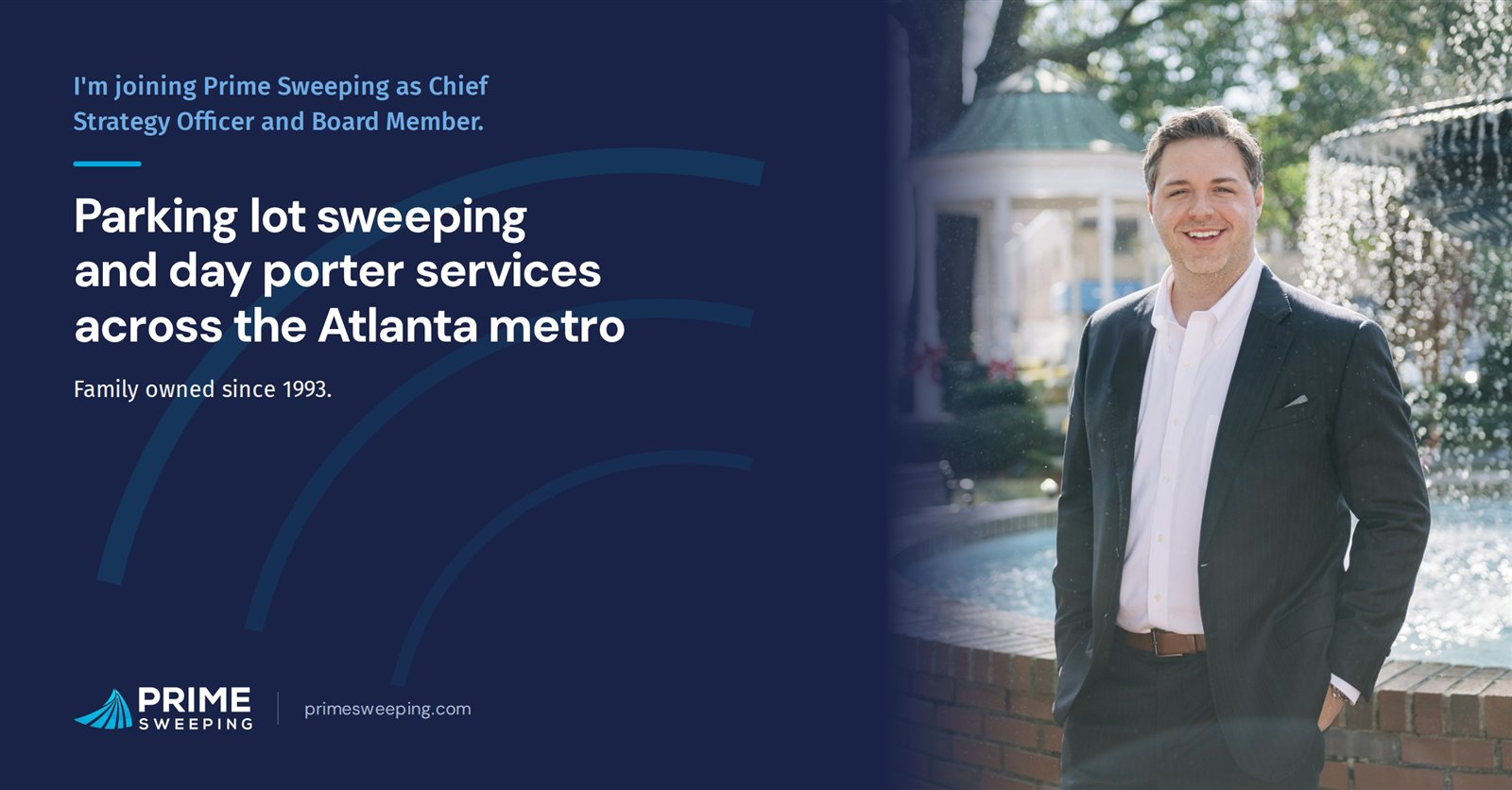
We started at Prime Sweeping as an advisor on pricing and sales in July 2026. By the middle of August I was a partner in the company, a member of its board and its Chief Strategy Officer. By the end of September the company was running on a staff site we built, with its pricing, routing, management, procedures and sales material written down and in one place. This is how that happened, what changed, and what we would do the same way for another owner.
The company
Prime Sweeping is a family-owned company in Duluth, Georgia, founded in 1993. It sweeps commercial parking lots overnight across metro Atlanta and provides day porters, lot upkeep and commercial pressure washing. It is a good business with long customer relationships and crews who know their properties.
Like most companies its age, a lot of how it ran lived with a few people. Which stops went on which truck, how long a property really took, what a new site should cost, and what to do when a driver called out at nine at night were all known, but known by people rather than written down. That works for running the company. It is a problem for growing it, and it is what a buyer discounts first.
Starting with the money question
The first engagement was narrow: are the prices right, and where does the company make money? We answered it with the company's actual records. The crews' job punches showed how long each property actually took and how long the drive between properties was. The books showed what each customer paid. Joining the two, site by site, gave a profit and loss for every property on the schedule.
That model did two things. It showed the partners which properties carried the company and which did not, so repricing conversations started from evidence. And it gave us the inputs for a pricing tool. We fit on-site time to the things a salesperson can see on a lot, such as its size, how many islands and sidewalks it has, how many trash cans and how often it is serviced, and turned that into a calculator anyone at the company can use. The method is written up in our article on pricing field service work from measured time.
None of that is unusual consulting work. What made it different was that the partners could see the next steps as clearly as we could, and the next steps were bigger than a pricing engagement.
Why it became a partnership
By mid-July the partners and I had signed a memorandum of understanding that set out what I would bring: route and profit-and-loss work on the operations side, and sales and marketing support. In August I joined the company as a member with an ownership interest, and took the CSO role and a seat on the board.
A partnership made sense for both sides. The partners wanted someone working on the company's next several years with the same stake in the outcome they had. I wanted the work to be measured by what it did to the company, and an ownership interest measures that better than an invoice does. It also meant decisions were written down from the start. One of the first documents I wrote for the partners spells out who decides what: which actions need a member vote, which the board can take alone, and how a member separates. Our article on who decides what in a small company covers why that document matters.
What changed in ninety days
From July to the end of September, the work moved out of spreadsheets and into a private staff site I designed and built for the company, behind one sign-in. The pieces, in the order the company felt them:
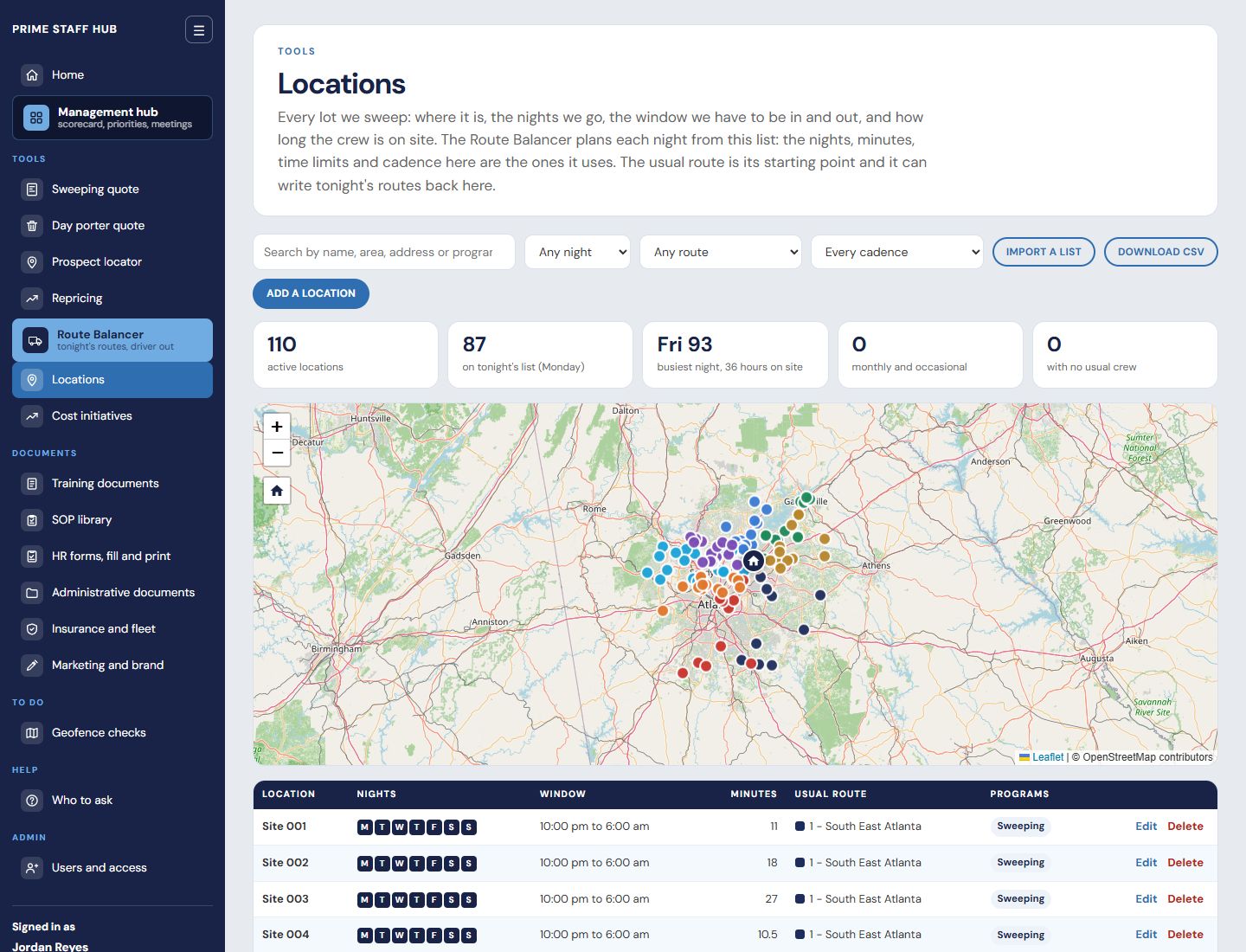
- Route balancing. Pick the night, mark who is out, and the tool rebuilds every route inside the shift limit and prints the sheets. The person who used to do it in their head now checks it.
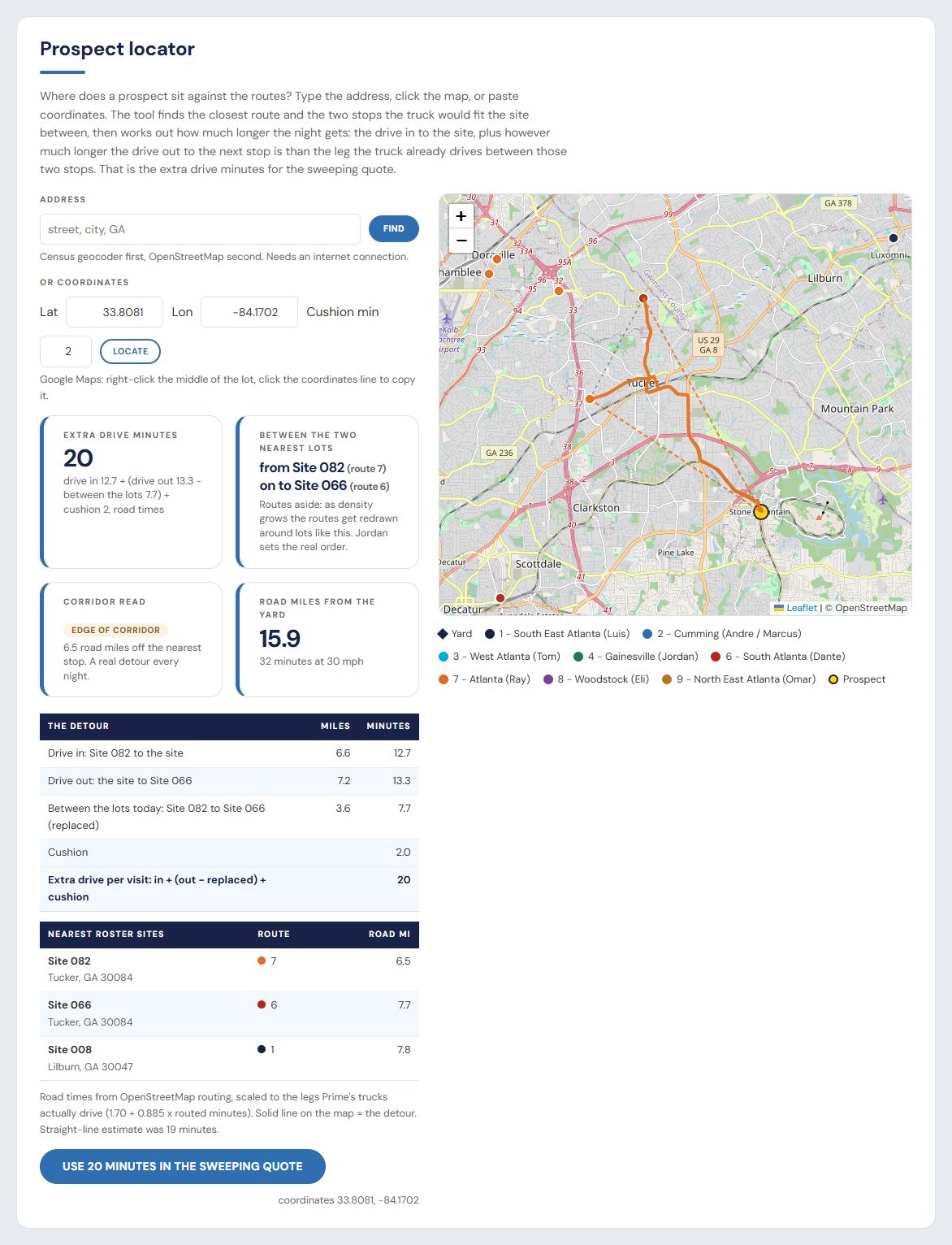
- Prospecting. Type an address and the prospect locator finds the two nearest properties the company already services and the extra drive time of fitting the new one between them. A salesperson knows whether a lead is on the way before quoting it.
- Quoting and repricing. New sites are priced from measured time. Existing sites can be repriced against the same model, with a standard annual price adjustment letter the board approved.
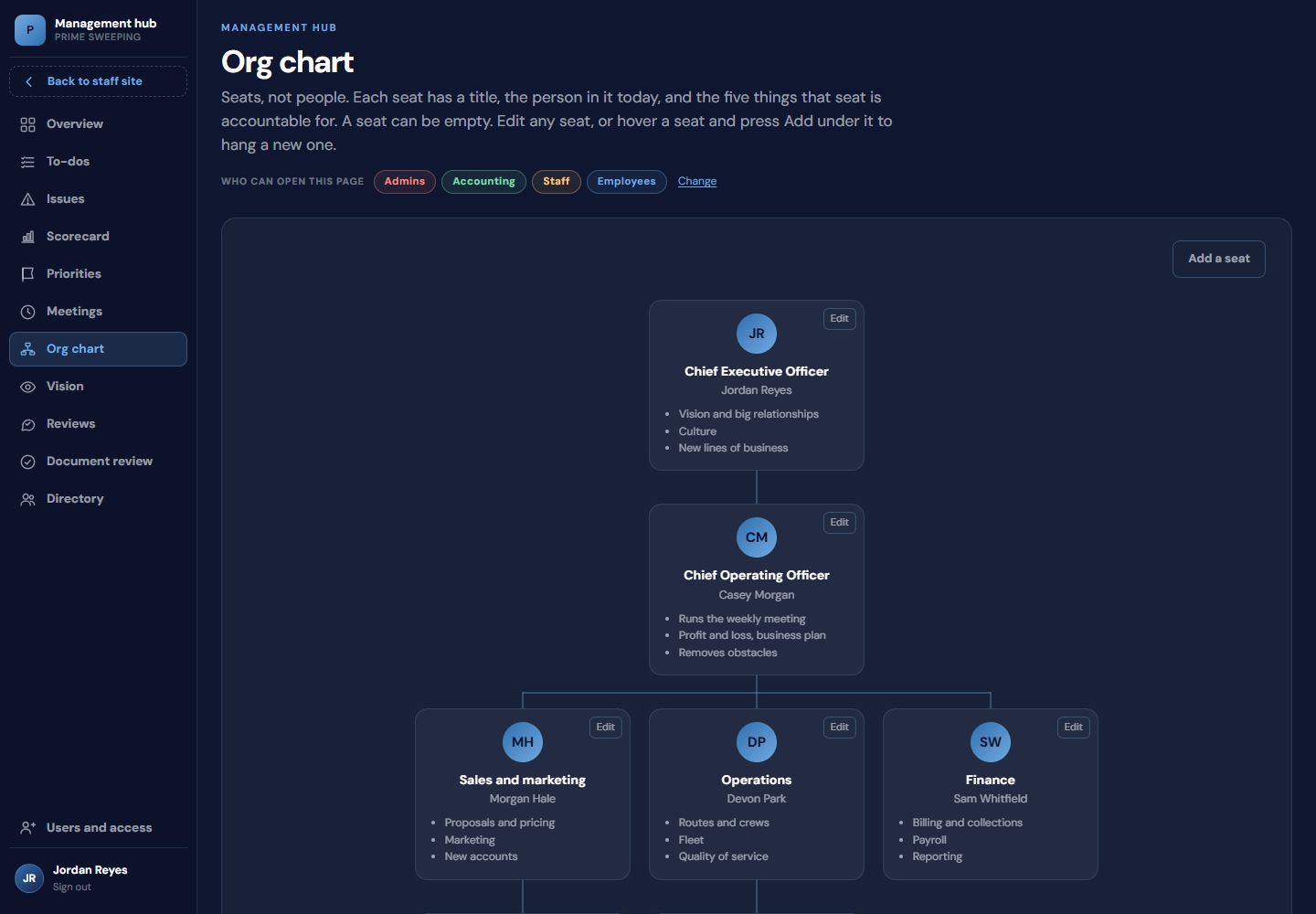
- A management hub. A weekly scorecard, quarterly priorities, an issues list, to-dos, the weekly meeting and an org chart with a named person in each seat.
- Written procedures and HR. Twenty procedures across five departments, with screenshots and the reasons behind each step, and thirteen HR forms that match the employee handbook.
- Brand and sales material. A written brand system, logo files with rules for using them, client packets, a pricing explainer for customers and standard terms that attach to every proposal.
Each piece took something that depended on a person and made it something written down that the company runs on. What We Built shows every screen, with sample data in place of Prime's real figures.
What a normal week looks like now
The easiest way to see the change is to follow the ordinary events of a week.
A driver calls out. Before, the night depended on one person being reachable and remembering how the stops fit together. Now whoever is on duty opens the balancer, marks the driver out and prints the new sheets. The routes respect the shift limit, and the change is on record the next morning.
A lead comes in. Before, the question of whether a property was worth taking waited for the owner to look at a map. Now the salesperson runs the address through the locator, sees how it sits against the routes already running, and prices it from measured time. If it is far from every existing route, the quote says so in the price.
The leadership team meets. Before, decisions were made in conversations. Now the weekly meeting runs from the hub: the scorecard first, then the quarter's priorities, then the issues list, and every decision leaves a to-do with one owner and a date.
Someone new starts. Before, training was a ride-along. Now there is a written procedure for the job, with screenshots, and the HR paperwork matches the handbook.
None of these events is dramatic. That is the point. A company is worth more when the ordinary week does not need any one person to go right.
What it means for the value of the company
We measure the work against the four things a buyer and a lender look at first.
- Runs without the owner. Routing, pricing, prospecting and the weekly management of the company now run from written tools and procedures. That is the single largest driver, and it is where most of the work went.
- Recurring or contracted revenue. Standard terms on every proposal and a scheduled annual price letter make the revenue that already renews easier to document and defend.
- Customer concentration. The site-by-site model makes concentration visible, so it can be managed on purpose.
- Clean financials. The profitability model is reconciled to the books, which means the numbers a buyer would test have already been tested.
Prime is not for sale, and the point of the work is a stronger company whether it ever is. But it is the same work we would do for an owner one to three years from a sale, and the result is the same: a company a buyer can understand without the owner in the room.
What we would do the same way again
- Start with money. Pricing and site profitability earned the trust that everything else was built on.
- Build on real data. Every tool runs on Prime's actual operating records. Nothing was configured around an average company.
- Write it down as you go. Procedures, decision rights and brand rules were written while the work was fresh, instead of in a rush before a sale.
- Partner only when both sides want it. The partnership came out of work that was already going well. That is the only way we take one on, and we take on a handful a year.
Most owners will not need a partner. Many will get most of the value from the Advise track, which is the same work without the ownership interest. Our article on working with a broker before you sell lays out the three ways we work.
If your company runs through a few people
If the way your company prices, schedules or sells still lives with you or one key person, that is the work we do. The first step is a working session on your Exit Roadmap, about an hour at no charge. You can book a time here.