You price route-based field service work from measured time by building every quote out of numbers the company already records: minutes on site from the time clocks, labor and equipment costs from the books, visits per week from the contract, and the drive minutes a new stop adds to the route it will ride. Then you check the result against the rate the company has to bill to hit its target margin before anyone sends it. Once that model exists, the price stops depending on who runs it, and a salesperson in their first week produces the same number the owner would. That is the pricing system I built for Prime Sweeping, a company I am a partner in: our firm holds an ownership interest, a seat on the board and the Chief Strategy Officer role, so I use this system and live with its numbers. This article walks through how it works and why it matters when the business is eventually valued.
Why gut pricing is owner dependence in its purest form
In many owner-run companies, pricing lives in one head. The owner drives the property, looks at the lot, thinks about which truck is nearby and names a number. Often the number is good. The owner has years of nights behind it and knows which layouts eat time and which customers call every week.
The problem is that none of that knowledge is written down. A salesperson cannot quote without calling the owner. A manager cannot tell whether an account is profitable without asking. And when the owner is on vacation, sick or trying to step back, new work either waits or gets priced by someone guessing. Every other form of owner dependence has a partial workaround: a manager can run a meeting, an office lead can handle payroll. Pricing is where the owner's judgment turns directly into revenue and margin, so when it cannot be delegated, the owner cannot leave.
A buyer sees this immediately. Of the four value drivers we work on with owners, the first is whether the company runs without the owner day to day, and it is the single largest. A company where one person sets every price is a company where that person is the business. The fix is to take the judgment out of the owner's head and put it into a model the team can run.
What a quote is made of when you measure it
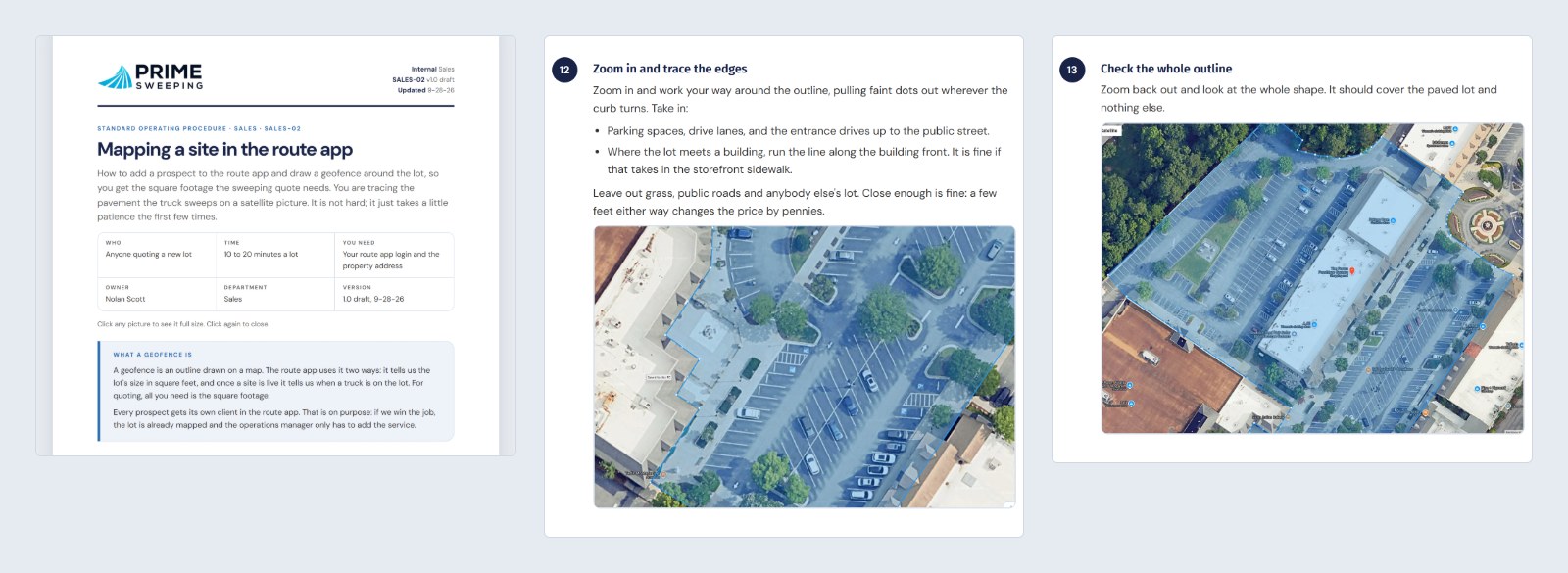
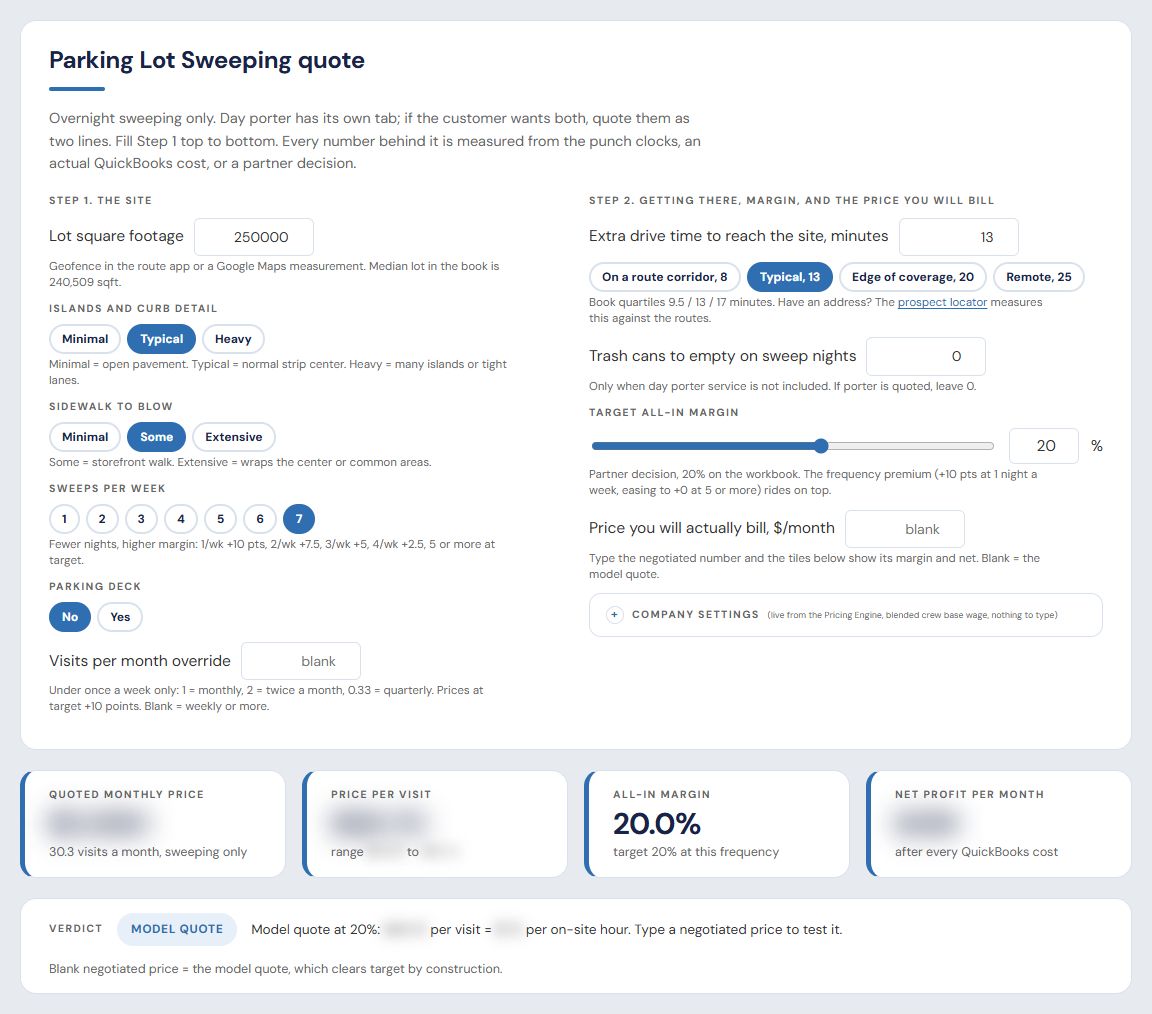
A sweeping quote at Prime starts with six questions about the site: things like lot size, layout and sweeps per week. The lot size is measured: the salesperson traces the paved area on a satellite picture in the company's route app, and the square footage comes out of the outline. That tracing has its own written procedure, so anyone quoting a new lot measures it the same way. The tool turns those answers into minutes on site, using the company's own time clock history for comparable properties. It adds the drive minutes the stop costs the route. Then it prices those minutes with the company's actual costs from its accounting. The output is a monthly price and a price per visit.
None of the inputs are opinions. The minutes come from what crews have actually logged. The costs come from the books the accountant closes each month. When the time clocks show a certain kind of layout takes longer than the old rule of thumb assumed, the model picks it up the next time it is run, and so does every quote after that.
This is the same idea behind the quantitative modeling we describe on our consulting page: push cost down to the level where decisions get made. For a route business that means the job, the route, the crew, the contract and the customer. Revenue is easy to see at the company level. Margin only becomes visible when cost is carried down to the unit someone is actually pricing.
Checking every quote against the company's target margin
Building the price from measured time is half of it. The other half is the check. Every quote is compared to the rate the company must bill to hit the company's target margin, and the tool shows a verdict next to the price. A salesperson can see at a glance whether the job they are about to propose clears the bar or falls short of it.
That check changes the conversation inside the company. When a prospect pushes back, the salesperson knows how much room exists before the job stops making sense, and the owner no longer has to be the only person who can say yes or no to a discount. When a job comes in below target, it is visible before the contract is signed, and a decision to take it anyway is made on purpose, by someone who can see the number.
The quote is a calculation, not an opinion, and that is what lets a new salesperson quote like the owner on their first day. You can see the full quoting screen in the quoting section of What We Built.
The minutes a new site adds to a route
Drive time is the part of a route job that is easiest to miss, because it is invisible at the moment of the sale. A property looks like any other property. What makes it expensive or cheap is where it sits against the routes already running.
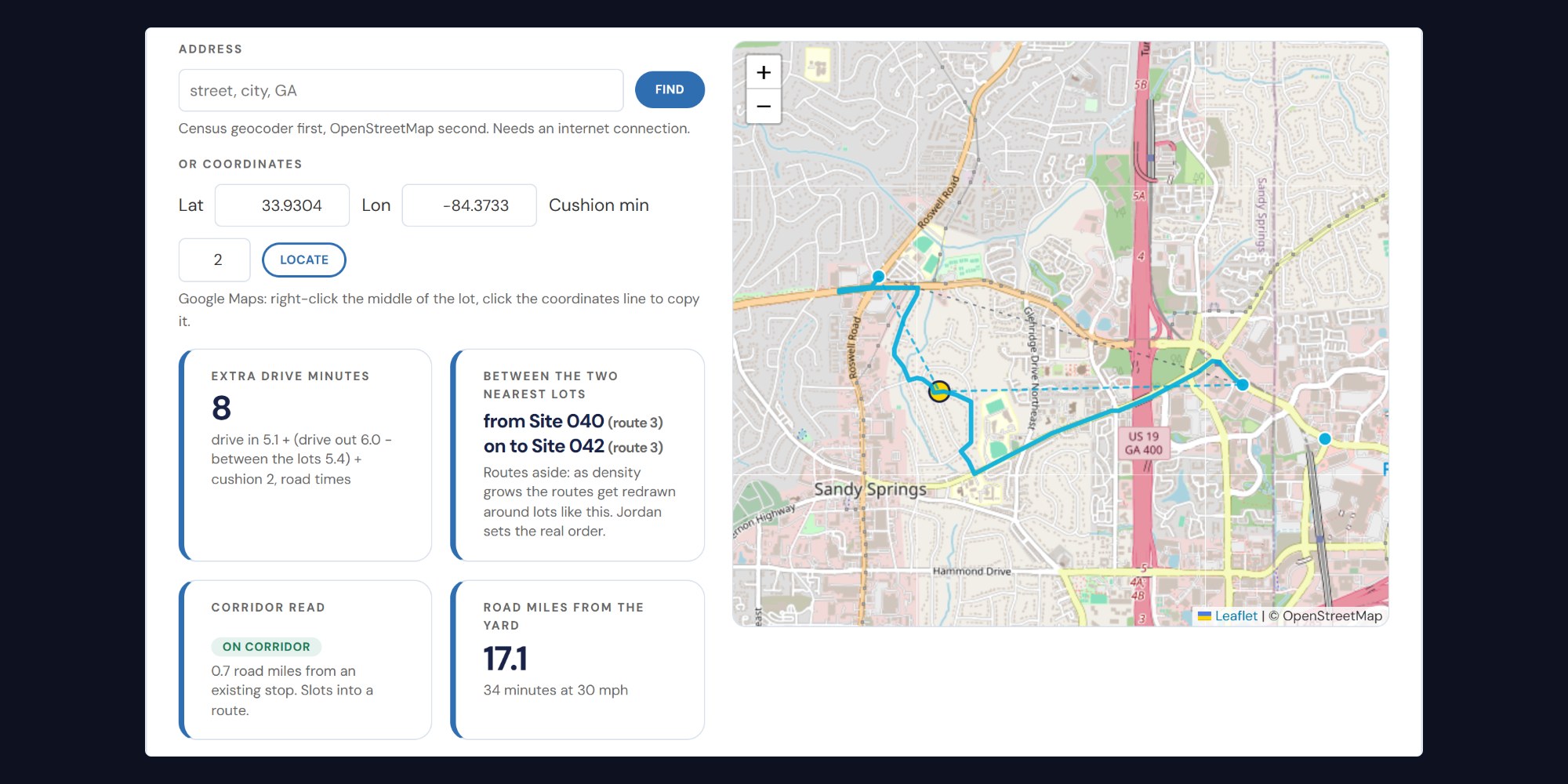
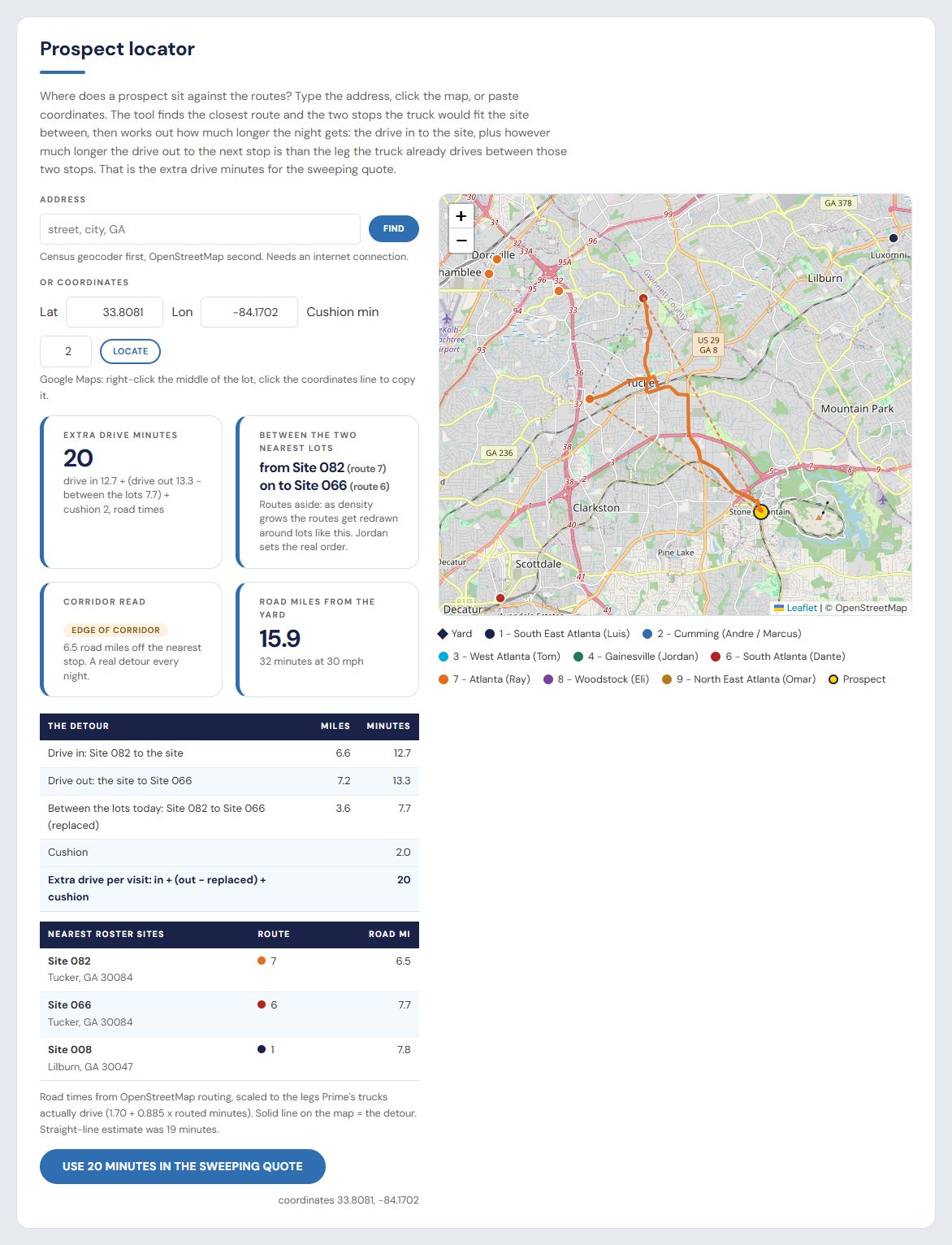
The prospect locator answers that question before the quote goes out. A salesperson types an address or drops a pin. The tool finds the two nearest lots the company already services, on any route, and works out the extra drive minutes of fitting the new site between them, plus a small cushion. The routes themselves come second: as a part of town fills in, they get redrawn around lots like this. Those minutes go straight into the quote.
The example on the prospect locator section uses sample data. A prospect sits 6.5 road miles from the nearest stop. The truck would drive 12.7 minutes in from the nearest lot and 13.3 minutes out to the next, against the 7.7 minutes between those two lots today, plus a two-minute cushion. That is about 20 extra minutes, every night the site is serviced. The tool flags the site as the edge of the corridor, so the detour is priced into the quote up front. Without that lookup, the 20 minutes show up months later as a route that runs long and a crew that clocks more hours than the contract was priced for.
The owner used to carry this map in their head. Now it is on a screen anyone on the sales team can use, and it gives the same answer every time.
Repricing the accounts you already have
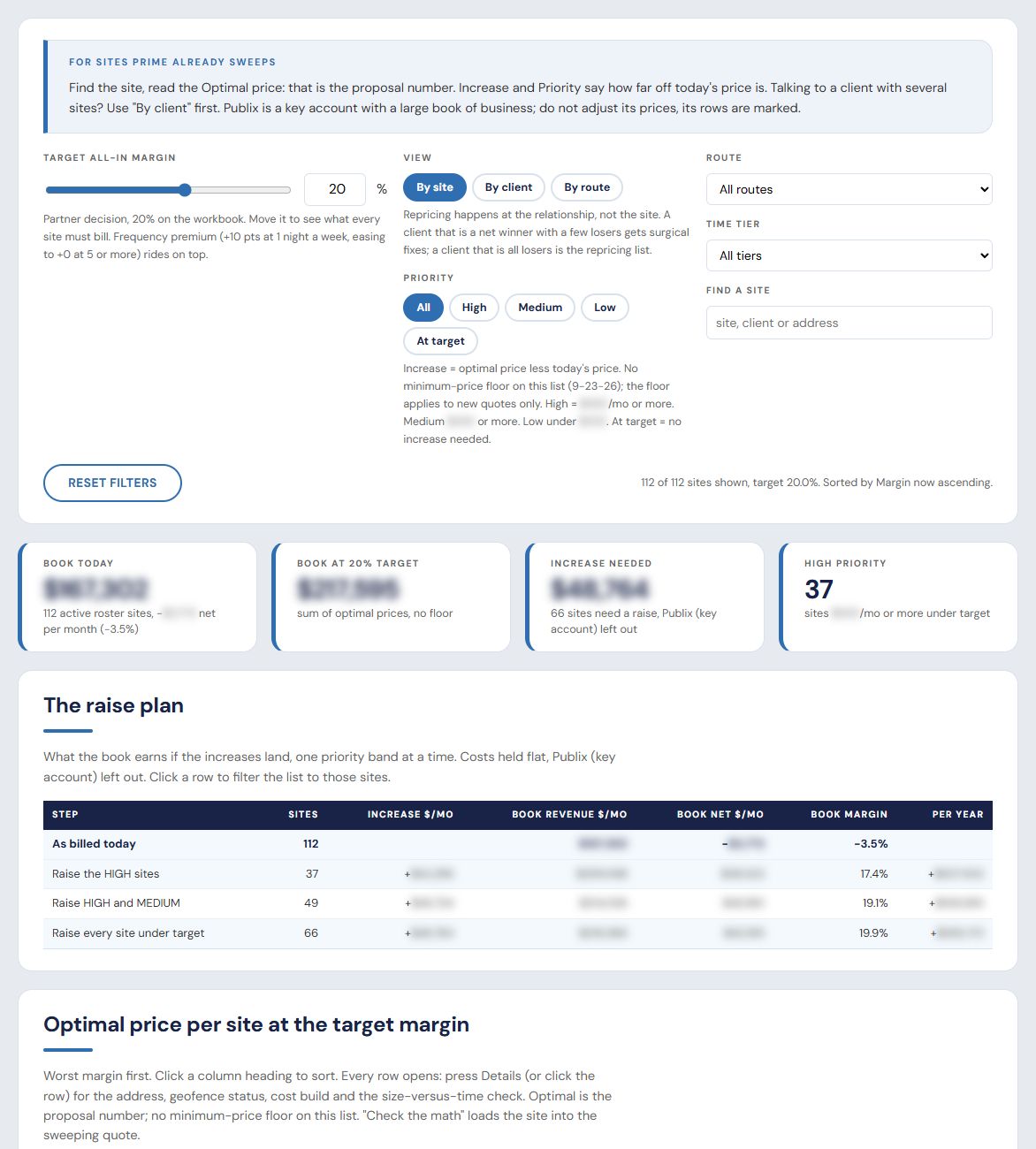
Once a pricing model exists for new work, the obvious next question is what it says about the existing book. Prime runs the same model over every current account. The repricing plan lists each one, sorted by how far it sits below the company's target margin, with the letter to send.
This is where the second question from the consulting work gets answered: which customers and contracts are subsidising the rest. In a company that has grown over years, it is common to find that some accounts were priced when costs were different, some were won with a discount that never came off, and some sit at the far end of a route that has since changed. At the account level, nobody sees it. In a sorted list, the accounts at the bottom are obvious.
Repricing is a judgment call, and the model does not make the call. It gives the owner and the account manager the facts to make it with: how far below target each account is, what a price change would do to the margin on that stop, and what losing the account would do to the route and to capacity. A price increase on a stop that sits in the middle of a dense route is a different decision from one on a stop that adds a long detour. The model shows the difference, and the company decides.
It also turns a hard conversation into a routine one. The annual price letter and the repricing playbook sit in the company's document library, so the process runs the same way every year whoever sends it.
Routes that balance without the owner
Pricing from measured time only holds if the routes themselves are run from the same data. Prime runs its sweeping routes overnight. The Route Balancer lets the office pick the night, mark who is out and press Balance. The tool reorders every stop across the trucks that are running, keeps every driver inside the shift cap, draws the routes on a map and prints a run sheet per driver.
A ladder view tries the night with one fewer truck per row and shows the longest night and the stops moved for each, so the decision about how many trucks to send is made on numbers. When a driver is out, their stops move to the trucks that are in and the map redraws. Lots with late openings or early deadlines are respected in the order.
All of this runs off one list of locations: every property, its nights, the time window it can be swept in, the minutes the crew spends there and its usual route. When a customer changes their hours, the office edits the stop once and tonight's routes pick it up. The minutes in that list are the same minutes the quote was built on, so the price, the route and the crew's night all agree.
What a buyer sees in a pricing model
A buyer or a lender reading an offering memorandum wants to know that the margin will survive the owner leaving. A written pricing model with the company's own time data behind it answers that directly. It shows how every job is priced, that the method does not depend on one person, and that existing accounts have been checked against the same standard.
It also touches the other value drivers. A book of contracted accounts, each priced to target, is recurring revenue a buyer can underwrite. A repricing list shows whether any single customer is carrying more of the margin than it should. And cost pushed down to the job and the route means the financials tie out at a level a buyer's accountant can test. Owner dependence shows up in the multiple, and on the consulting page we use one worked example: on earnings of $850K, half a turn is over four hundred thousand dollars at closing, and it is the same business. If you want to see how those drivers feed a valuation, our article on what your business is worth covers it.
Where to start if your prices live in your head
You do not need a full staff site to begin. Most owners already have the raw material: time clock records, a monthly close from their accountant and a list of accounts with their visit schedules. The first step is getting minutes per job and cost per minute into one place, then running the existing accounts through it. The sorted list that comes out of that exercise is usually enough to show where the work is.
If you run a route-based service company and want to talk through what a pricing model would look like on your own data, book a time with me. We start with a conversation about where your time goes and which decisions still wait on you.