
A salesperson sells the way the owner would when the owner's explanations are already written down and handed to the customer: a plain account of how the price is built, references the customer can check, standard terms that come with every proposal, and a yearly price letter that arrives on a schedule. Behind that client-facing shelf sits an internal playbook that tells the salesperson where each number comes from and what they may offer when a customer pushes back. At Prime Sweeping, an overnight parking-lot sweeping and day porter company in metro Atlanta and a company I am a partner in, I built that set of documents. This article covers what is in it, why it keeps the owner out of most price conversations, and how a buyer reads a sales process that runs on paper.
What sits on the client-facing shelf
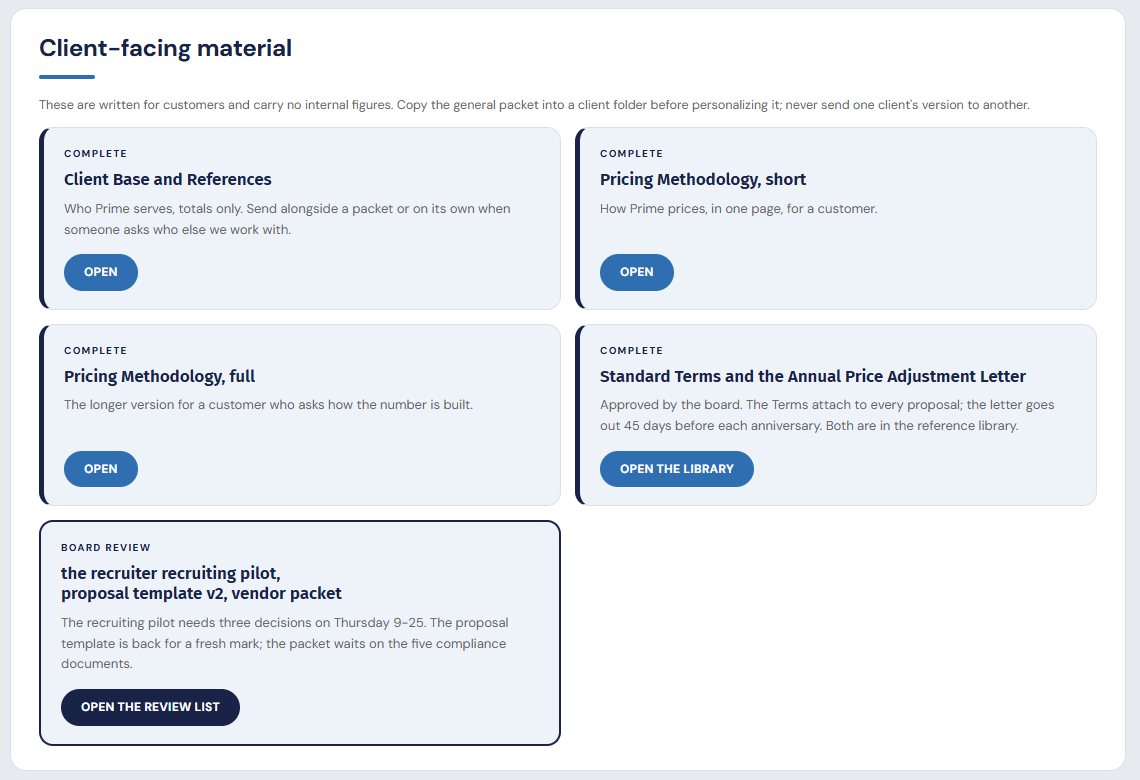
Prime's staff site has a marketing page, and part of it is a shelf of documents meant for customers. There are five items on it today, plus two in progress.
- Client Base and References. Who Prime serves, in totals only. It goes out with a packet, or when a prospect asks who else we work with.
- Pricing Methodology, short. How Prime prices, on one page, written for a property manager.
- Pricing Methodology, full. The longer version, for the customer who wants to see how the number is built.
- Standard Terms. Approved by the board. They attach to every proposal, so no two customers sign different versions of the basics.
- The Annual Price Adjustment Letter. Also approved by the board. It goes out 45 days before each contract anniversary.
A proposal template and a vendor packet are still under board review. The partners review documents on the site itself: each one marks Approve, Disapprove or Propose a change, with the change typed in, one mark per person per document. Nothing reaches a customer until it has been through that.
The shelf matters because each of these documents replaces a conversation the owner used to have personally. When a prospect asks for references, the salesperson sends the reference sheet. When a customer asks why the price is what it is, the salesperson sends the methodology. The owner's answers still get given. They just no longer need the owner to give them.
A customer who understands the price argues less about it
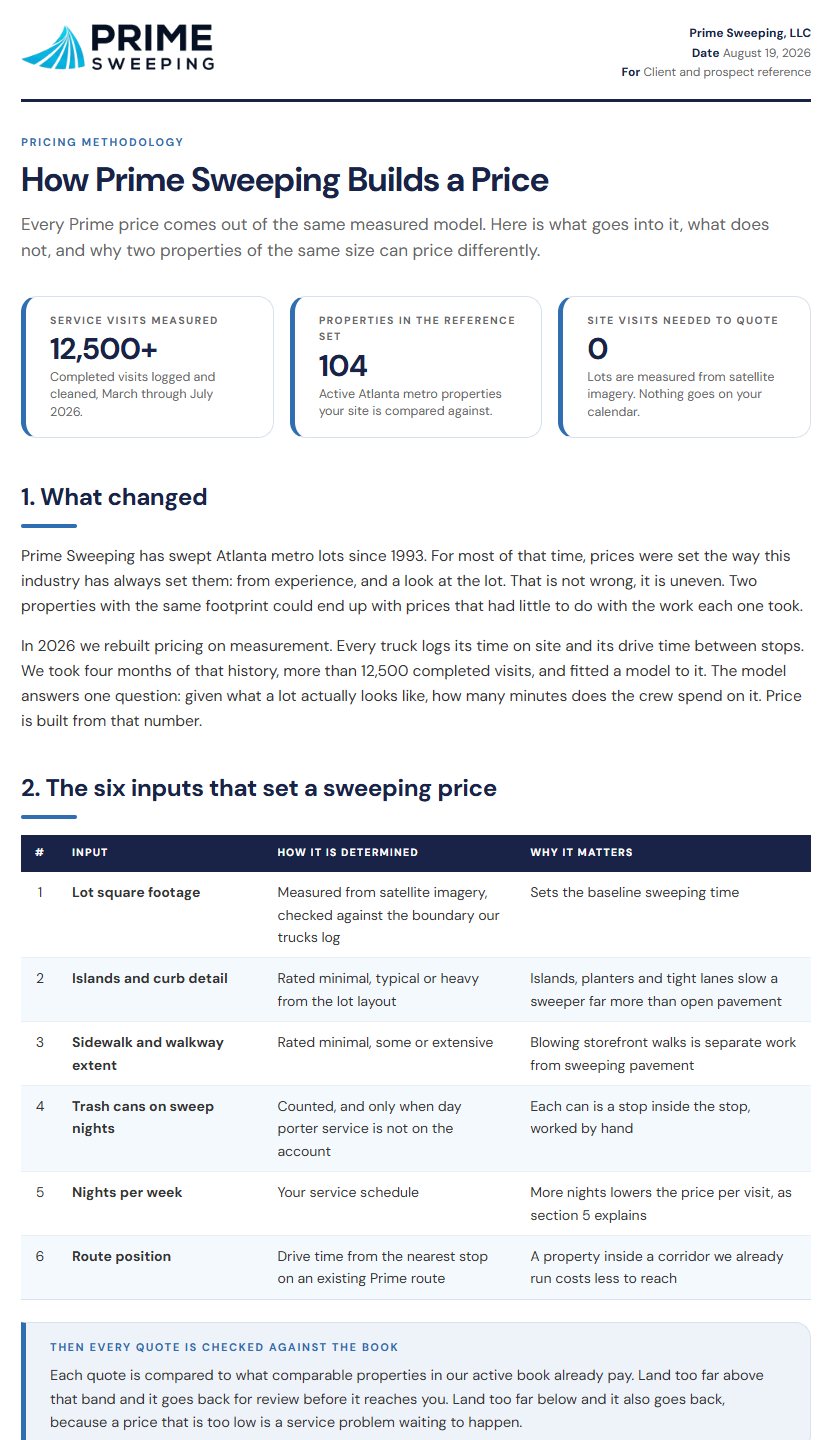
The pricing explainer, titled How Prime Sweeping Builds a Price, is the document I would point to first. It tells the customer that every Prime price comes out of the same measured model. In 2026 the company rebuilt its pricing on measurement, and the model was fitted to four months of history covering more than 12,500 completed visits. A reference set of 104 active Atlanta metro properties sits behind it. Lots are measured from satellite imagery, so no site visit is needed to quote.
It names the six inputs that set a sweeping price:
- Lot square footage.
- Islands and curb detail.
- Sidewalk extent.
- Trash cans.
- Nights per week.
- Route position, meaning where the property falls on the route that would serve it.
Every quote is then checked against what comparable properties already pay. And the explainer is just as specific about what does not set the price: a guess, the previous vendor's price, a property walk, the hour of service, or lot size on its own. Day porter services are priced separately, on their own terms.
That last list does a lot of work. A lot of the pushback I hear on a price is a customer testing whether the number is soft. If the price came from a salesperson's judgment, it probably is, and pushing makes sense. If the customer has already read that the price comes from six measured inputs and a comparison against similar properties, the question changes from "can you do better" to "is my lot measured right." That second question has an answer, and the salesperson can give it without calling anyone.
The model behind the explainer is the one I described in pricing field service work from measured time. The explainer is the customer's view of it, with every internal figure left out.
Keeping internal numbers inside
The rule written at the top of the client-facing shelf is short: these documents are written for customers and carry no internal figures. No costs, no margins, no target rates, no route economics. The explainer says what goes into a price. It never says what Prime earns on one.
The second rule is about handling. The general packet is copied into a client folder before anyone personalizes it, and one client's version is never sent to another. That sounds like housekeeping, and it is, but it prevents two real problems. A salesperson editing the master copy slowly turns the company's standard material into whatever the last customer needed. And a personalized packet sent to the wrong property manager discloses one customer's arrangement to another, which is the kind of mistake that ends a relationship.
The same separation runs through Prime's document library. Internal documents (the handbook, job descriptions, who can decide what, how the pricing model was built, the sales and repricing playbooks) sit apart from client-facing ones. A new salesperson can tell by where a document lives whether it may leave the building. The visual side, meaning the logos, templates and brand rules that make every proposal look like it came from the same company, is covered in building a brand system for a service company.
The annual letter as routine
In many of the owner-run companies I see, a price increase is an event. The owner decides it is time, picks up the phone, and has an uncomfortable conversation with a customer who has not heard from the company in a year except through invoices. Because it is uncomfortable, it gets put off, and prices on older accounts drift while costs keep moving.
Prime's Annual Price Adjustment Letter is built to take the event out of it. The board approved the letter alongside the Standard Terms that every customer receives with their proposal. It goes out 45 days before each account's anniversary, every year, for every account. The customer gets notice with enough time to plan, from a company that told them at the start how its prices are built. The salesperson sends a document the board has already approved, on a date the calendar already set.
What changes is who the conversation belongs to. When the letter is routine, a customer who calls about it is asking a question about a standard document, and the salesperson can answer it. When the increase is the owner's personal decision, the customer wants the owner, and usually gets them.
Objections written down before they happen
The client-facing shelf has an internal counterpart: a repricing playbook written for the salesperson. It covers three things.
Where the number comes from. The salesperson needs to understand the model well enough to explain it without the explainer in hand. The playbook walks through it in the salesperson's terms, including the internal side the customer never sees.
Annual adjustment versus repricing at renewal. These are different conversations. The annual adjustment is the routine letter. Repricing at renewal is when an account the model shows sitting below where it should be gets reset. The playbook keeps the two apart and gives the steps for each, so a salesperson does not turn a routine letter into a renegotiation or wave through a renewal that needed one.
Every objection, with a boundary. For each objection the playbook lists, it says what the salesperson may offer on their own and what goes up to the manager. A customer who says the last vendor was cheaper, or who asks to skip this year's adjustment, gets an answer the salesperson is authorized to give, and anything past that line has a named next step.
This is the part that keeps the owner out of the discount decision. In a company without it, every concession is improvised, and an improvised concession is one the salesperson will not make without asking. So they ask the owner, the owner decides, and the owner remains the pricing department whatever the org chart says. Writing the boundary down in advance lets the salesperson act inside it with confidence, and it means a request that reaches the manager is one that actually needed the manager.
The same pattern appears across the tools on Prime's staff site: the quoting tool, the repricing plan and the library all exist so that a salesperson prices a job the way the owner would. You can see screens from all of it on What We Built, with names changed and dollar figures blurred.
How a buyer reads a sales process that runs on documents
When a buyer looks at a service company, one question sits under most of the others: what happens to revenue when the owner leaves? Of the four value drivers we work on with owners, the first and largest is whether the company runs without the owner day to day. A buyer discounts owner dependence, and it shows up in the multiple.
Sales is usually where that dependence is hardest to see and hardest to fix. Operations can be observed. A route runs or it does not. Selling happens in phone calls and handshakes, and a buyer reviewing the company cannot sit in on them. What a buyer can review is paper. A pricing method the customers themselves have read. Standard terms on every contract. A yearly letter that has gone out on schedule. A playbook that says who may offer what. Each of those is evidence that the price holds when the owner is not in the room.
It also supports a second value driver. Contracted revenue is worth more when the contracts are consistent, and a book of accounts signed on the same terms, adjusted on the same schedule, is easier for a buyer and a lender to underwrite than one where every customer has a different deal the owner remembers.
None of this requires a large company. Prime runs its sweeping routes overnight. The documents are a handful of pages each. The work is deciding what the owner actually says to customers, writing it down once, and getting the partners to approve it.
Where an owner can start
If your salesperson still calls you before sending a proposal, that is the place to begin. Write down how you arrive at a price in terms a customer could read. Pick the terms you want on every contract. List the objections you hear every month and decide, before the next one, what your salesperson may offer without you. That is the kind of work we do with owners one to three years before a sale, and it is laid out on our consulting page.
If you want to talk through what your own sales process would need, you can book a time with me. Bring a recent proposal and we will start from that.