
Write down which decisions a manager can make alone, which need a partner, and which belong to the board or the members, and put the section of the operating agreement that governs each one next to it. Then give the board one place to approve documents, with each partner's mark on the record. In many small companies the honest answer to "who can approve this?" is "the owner," for everything from a discount to a new truck. That answer is why the owner cannot step back, and it is one of the first things a buyer tests. Below is what a decision authority list contains, how the board of Prime Sweeping, a company I am a partner in, approves documents, and why access to information follows the same logic.
How the owner becomes the only yes
Nobody sets out to build a company where one person approves everything. It happens because the owner made every decision in the early years, made them quickly, and made them well, since the owner was the only one with the full picture. The habit outlives the reason. The company adds a sales manager, an office manager and a field supervisor, and each of them still brings decisions to the owner, because no one ever wrote down what they are allowed to decide on their own.
The result is a queue. A salesperson has a customer on the phone asking for a better rate and has to call back tomorrow. The office manager has a good applicant and cannot make an offer until the owner reads the resume. A supervisor needs a repair approved before a truck goes out. None of these are hard decisions. They wait because the rule is unwritten, and when the rule is unwritten everyone defaults to asking.
The cost shows up in three places. The owner's day fills with approvals that someone else could make. The managers learn to wait instead of decide, which is the opposite of what you hired them for. And the week the owner is sick or on vacation, decisions stop. The company runs at the speed of one inbox.
Why a buyer asks who decides
Of the four value drivers we work on with owners, the largest is whether the company runs without the owner day to day. A buyer discounts owner dependence, and that discount shows up in the multiple. On earnings of $850K, half a turn is over four hundred thousand dollars at closing, and it is the same business.
Decision rights are one of the most concrete ways to show a buyer where the company stands. When a buyer asks what happens while the owner is away, "everything comes to me" tells them that after closing, everything will come to them, or to a manager they have not met, with no rules to work from. A written list that shows the sales manager already sets discounts within a range, and the office manager already hires into open seats, tells them the managers are making decisions today and the company has a record of how.
It also helps with the documents a buyer's advisors read. A company whose everyday practice matches its governing documents is easier to review than one where the operating agreement says one thing and the owner does another. This is part of the work I describe in why we work with owners as a fractional CSO before a sale: the gaps a buyer will find are cheaper to close a year or two early than to explain at the table.
What goes on a decision authority list
A decision authority list is a short document, often a single table. Each row is a kind of decision the company makes more than once. Each row answers three questions: who can make this decision alone, who has to agree before it is made, and who has to be told afterward. Most decisions fall into one of four levels.
- A manager, alone. Routine decisions inside a written limit. The manager decides and the company moves.
- A manager with a partner's sign-off. Decisions outside the routine limit, or ones that commit the company for longer than a season.
- The board. Decisions that change how the company operates: new standard terms, a new seat on the org chart, a large purchase.
- The members. The decisions the owners keep for themselves: bringing in a new owner, taking on significant debt, selling the company.
Some generic examples show how the rows read. These are illustrations of the format, and the limits in your company should come from your own numbers and your own agreement.
- Approving a discount. The sales manager approves discounts within a written range off the standard price. Anything outside the range goes to a named partner, and the owner is told at the weekly meeting.
- Hiring. A department manager fills an open, budgeted seat. Creating a new seat goes to the board, because it changes the org chart and the payroll plan.
- A vehicle or equipment purchase. Replacing a vehicle that has failed inspection is a manager decision with a partner's sign-off. Adding a vehicle to grow the fleet goes to the board.
- Signing a contract. A manager signs customer contracts on the company's standard terms. Any change to the standard terms themselves goes to the board.
The list pairs naturally with the org chart. The org chart says who owns which work; the decision authority list says what each seat may decide while doing it. If you have not built the first one yet, start with seats on the org chart and key-person risk, then write the authority list against those seats. Write it in the words your managers actually use. A list nobody can follow on a busy Tuesday does not change who gets asked.
Tie it to the operating agreement
At Prime, the Decision-Making Authority document sits in the company's documents library next to the handbook and the standard terms. It sets out who decides what under the operating agreement, Members versus the Board, with the section reference for every action. That last part is the discipline that makes the document trustworthy.
Putting a section number beside each row does two things. It forces someone to read the agreement closely, and that reading often turns up a surprise: a decision the agreement reserves for the members that the owner has been making alone for years, or an everyday decision the agreement never mentions at all. It also settles which document wins. The operating agreement governs, and the list is a plain-language map of it that a manager can use without reading the whole agreement.
A caution, stated plainly. I am a business broker, and our firm is not a law firm. Nothing in this article is legal advice. Operating agreements differ, state law fills in what an agreement leaves out, and whether your list matches your agreement is a question for your attorney. Draft the list in business terms, then have counsel read it against the agreement and confirm it before anyone relies on it. If the two disagree, counsel can tell you whether to change the practice or amend the agreement.
Board approvals without an email chain
Once decisions go to a board, the next problem is how the board actually decides. In many small companies it happens by email. A draft goes out, replies come back out of order, one partner comments on the second version while another approves the third, and a month later nobody can say with confidence which version was approved or by whom.
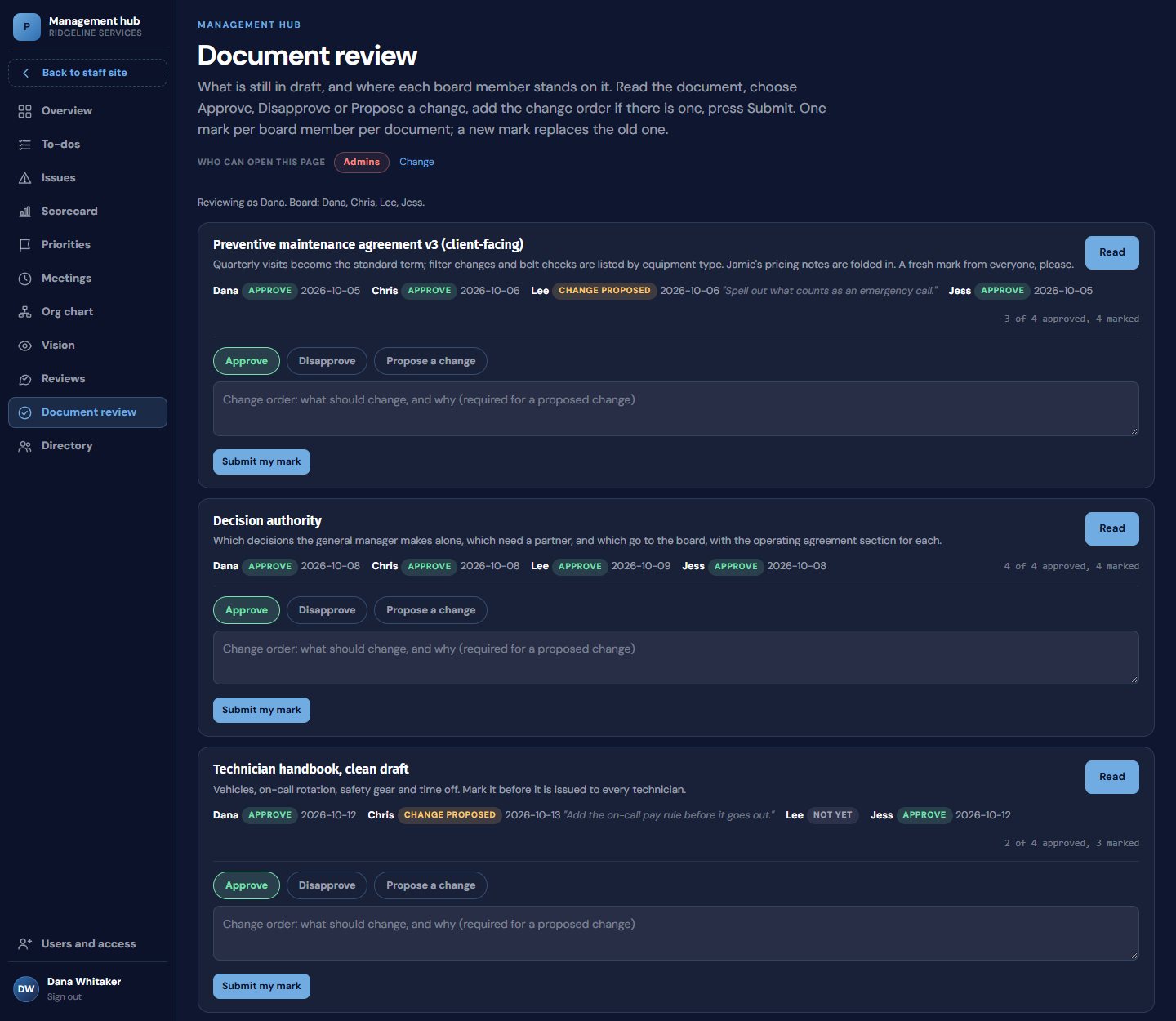
I designed and built Prime's staff site, and its management hub has a page for exactly this. The board approves documents without an email chain. Each partner reads the draft and marks Approve, Disapprove or Propose a change, with the change typed in. There is one mark per person per document, visible at a glance, so the state of every document is clear to everyone on the board.
That page is how the company's standard terms and its annual price adjustment letter were approved by the board. The terms attach to every proposal, and the letter goes out ahead of each anniversary, so both carry real weight with customers. Other documents, such as a new proposal template and a vendor packet, sit under review until every mark is in. The result is a record: what the board approved, who approved it, and what changes were asked for along the way. When a buyer or a lender asks how the terms were adopted, the answer is on one screen.
The same idea, applied to information
A decision authority list settles who may act. The other half of governance is who may see what. In a lot of companies that question is answered by a shared password, which means everyone sees everything, or by the owner keeping the sensitive files on one laptop, which means nobody else can find them.
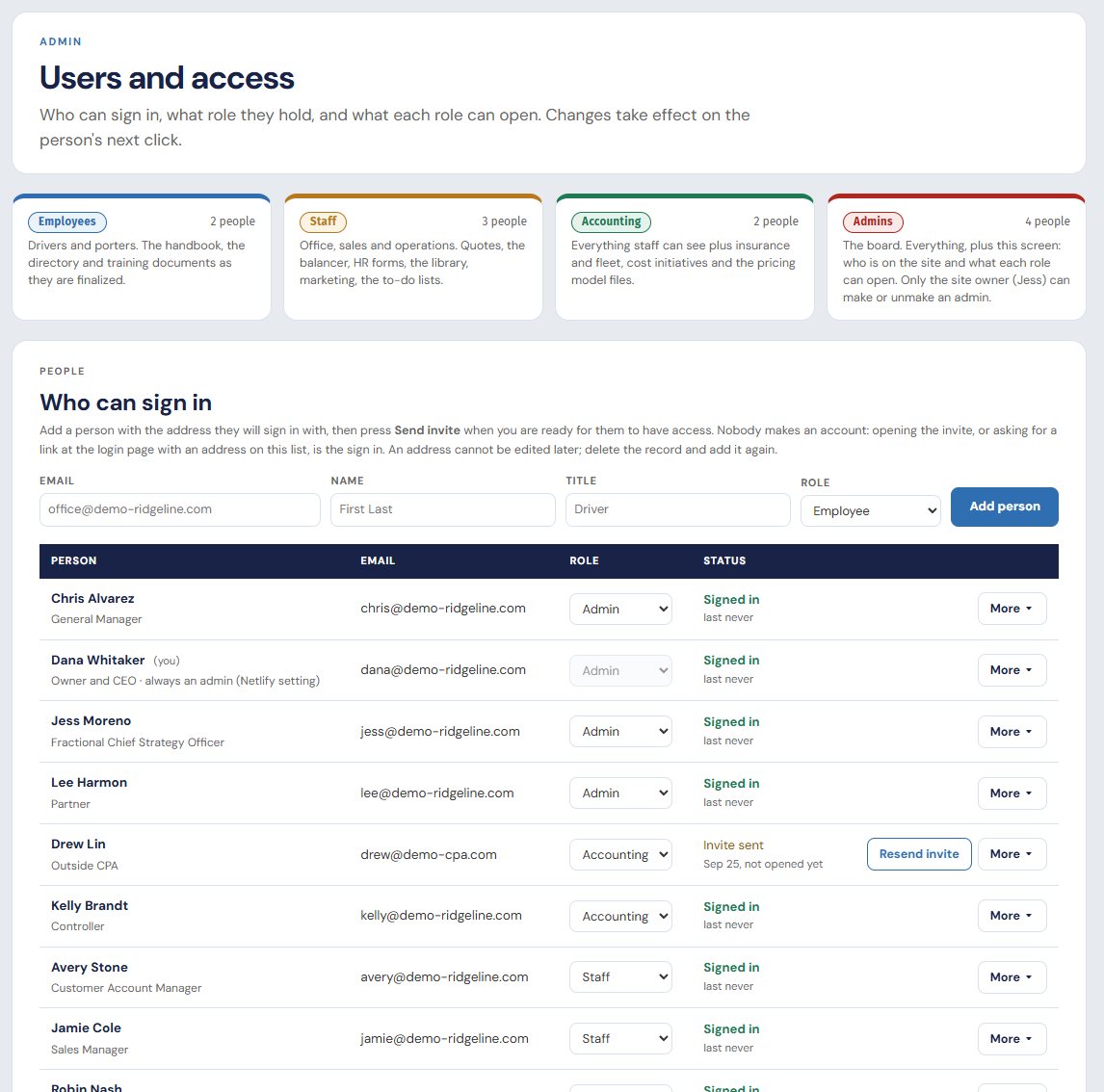
Prime's staff site handles it the same way the authority list handles decisions: written down, changeable in one place, and recorded. Each person signs in with their own one-time link sent to their email, so there is no shared password. Four access tiers (employee, staff, accounting and admin) decide what each person can open, so each person sees what their role needs. The owner can change any page's access with a tick, and every change is logged with who made it and when.
The logic carries over directly. When someone joins, their tier sets what they can open on day one. When someone changes roles, one tick changes their access. And when a buyer asks who can see payroll or customer pricing, there is a list to show them and a log behind it. You can see that screen in the users and access section of What We Built.
Where to start
You do not need software to begin. For the next two weeks, write down every decision that comes to you: what it was, who brought it, and how long it waited. At the end, mark the ones a manager could have made with a written limit. That marked list is the first draft of your decision authority list. Put the levels beside each row, find the section of your operating agreement that governs each one, and send the draft to your attorney to confirm. Then move board approvals out of email and into one place with a record.
This is the kind of gap we work through with owners one to three years before a sale, described on our consulting page. If you would like to talk through who decides what in your company, or what a buyer would make of it today, book a conversation with me.