
A business broker should work with an owner before the sale because the sale price is mostly decided in the years before the listing, by how the company runs, and very little can change it once the business is on the market. Most brokers meet a company the day it goes to market, when the price is already set. We would rather help set it. That is why the Nolan Scott Team works with owners in three ways, List, Advise and Partner, and why two of the three start before there is anything to list.
Where the price gets decided
By the time an owner calls a broker to list, the inputs to the valuation are fixed. The last three years of financials are what they are. The customer list is what it is. Whether the company can run for a month without the owner is either true or it is not. A good broker can present those facts well, find the right buyers and negotiate hard, and all of that matters. None of it changes the facts.
A buyer, and the lender behind the buyer, looks at four things before almost anything else, and they are the same four we work on:
- The business runs without the owner day to day. This is the single largest driver. A buyer discounts a company that lives in the owner's head, and the discount shows up in the multiple.
- Recurring or contracted revenue. Revenue that renews on its own is worth more than revenue someone has to go win again.
- No customer over 20 percent of revenue. Concentration is a risk the buyer prices in.
- Clean, reviewed financials. Books a buyer's accountant can trust without rebuilding them.
Every one of those takes time to move. You cannot document a company's operations, bring a second manager up to speed, rebalance a customer list or build a clean financial history in the ninety days before a listing. You can do it in one to three years. Small movements in the multiple are large numbers: on earnings of $850K, half a turn is over four hundred thousand dollars at closing, and it is the same business.
Few brokers offer anything before the listing. We built our model around the period before it, because that is where we can do the most for an owner, and because we ran companies before we brokered them. You can start on one track and move to another.
List: ready to sell in six to twelve months
This is traditional brokerage, done properly. If the business is ready, or close enough, there is no reason to spend a year on preparation you do not need.
The work is what a seller should expect from any serious broker, done by the person who will sit at the closing table:
- Recast financials and a seller's discretionary earnings valuation.
- A confidential offering memorandum written for buyers and lenders who read the whole thing.
- Buyer sourcing, screening and lender coordination.
- Negotiation of price and structure, and a managed close.
It costs nothing up front. The fee is a success fee at closing on a declining scale, paid out of proceeds, with a minimum set in the engagement agreement. If another broker brings the buyer, we split the fee with them, and the seller never pays a second fee. If you want a sense of where your number sits before you decide, our article on what a business is worth walks through how we build a valuation.
Advise: one to three years out, and the business still runs through you
This is the track for the owner who knows a sale is coming but can see that the company still depends on them for pricing, hiring, the weekly numbers or the key customer relationships. Here we work as a fractional Chief Strategy Officer on a flat monthly retainer.
The work starts from your Exit Roadmap, which lays out where the number is today and which value drivers move it. The roadmap produces a gap list, and the retainer buys progress on that list: documented systems, owner independence, financial rigor, key-person retention, and the software that takes administrative work off your desk. We report against the list, so you can see what has moved and what has not.
There are three levels, and each one is defined by what changes for you:
- Advisory Board. Two sessions a month and a direct line between them. You run the plan, and we keep it honest.
- Fractional CSO. A standing weekly session plus working time on the gap list. We own the roadmap and report to you monthly.
- Embedded. The CSO title, a board seat, and our hands on the systems build, working inside the company every week.
Pricing for each level is set in the engagement letter. The commitment is a three-month minimum to start, then six-month terms, which is long enough to finish real work and short enough that you are never locked into something that is not paying off.
The part owners ask about first is the credit-back. If you start on a retainer and later sell the business with us, the advisory fees you paid are credited against the closing fee, up to half of that fee. The credit applies to a listing signed within twelve months of your last retainer payment. You do not pay twice for the same outcome.
Partner: an operator with a stake in the result
Some owners want more than an advisor. They want someone who is in the company, carries some of the risk and is paid when the company does well. For those owners we join the company.
A partnership includes a board seat and the CSO role at Embedded scope. The work is the same as the Advise track, with an owner's attention behind it. The terms, in summary:
- The stake. A minority interest, typically 5 to 15 percent and sized to the company, vesting against milestones we agree on in writing: documented operations, key-person retention, clean financials, and revenue and margin targets.
- The work. Paid as a reduced retainer, plus our share of distributions.
- At a sale. We receive our vested share of the proceeds, with a minimum exit payment set in the agreement so the work is paid for whatever the outcome.
- If the engagement ends early. Vested interest is bought back at a formula price set in the agreement. Unvested interest is forfeited.
Vesting against written milestones is the point of the structure. We earn the stake by moving the company, and if we do not move it, we do not keep what we did not earn. We take on a handful of these a year, because each one gets real time.
What this looks like at Prime Sweeping
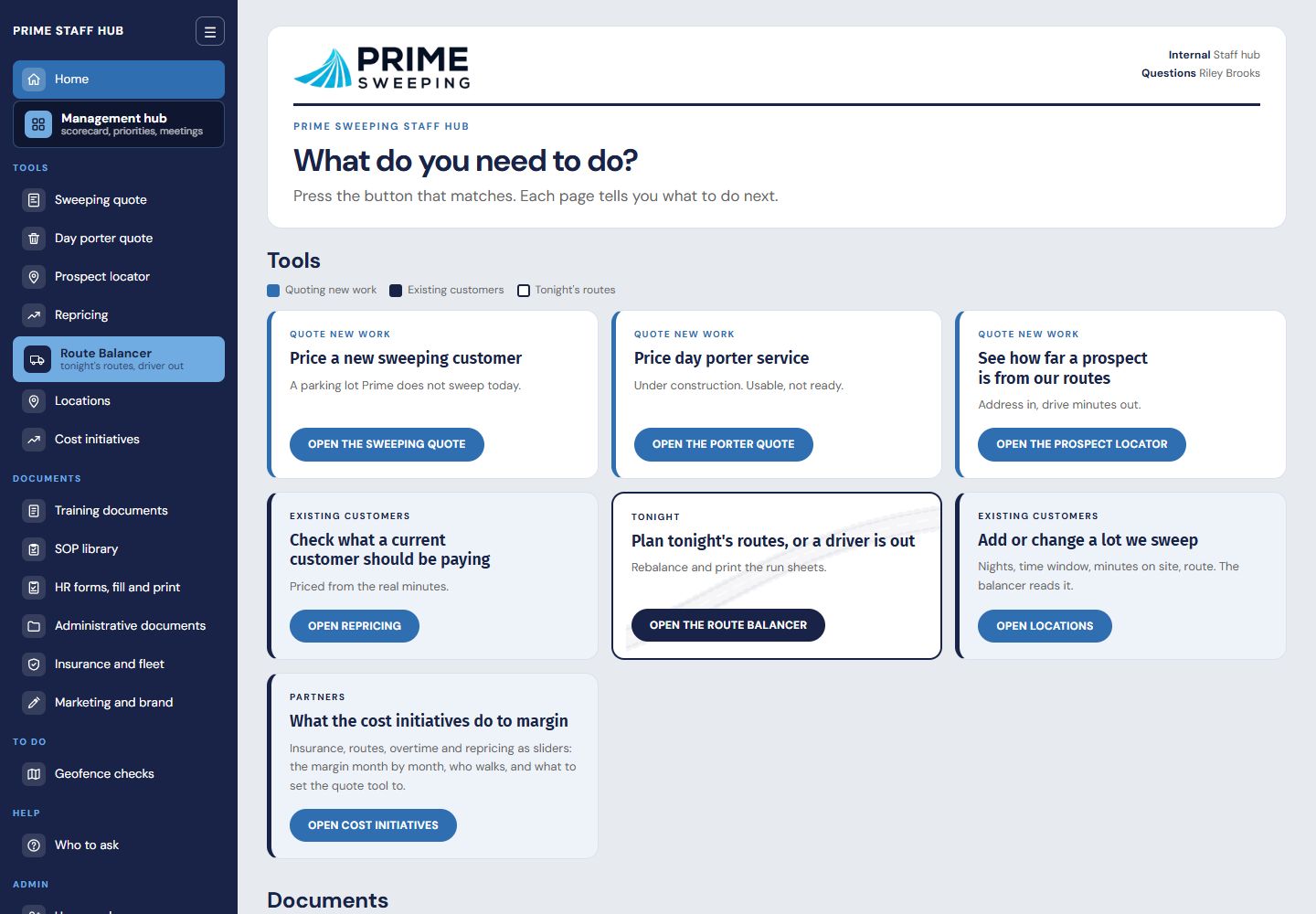
Prime Sweeping is an overnight parking-lot sweeping and day porter company in metro Atlanta. We came in as an advisor on pricing and sales. Today we hold an ownership interest, sit on the board and serve as Chief Strategy Officer. It is the Partner track, and it started as advisory work.
In September 2026 we built Prime one private website that the company runs on: route planning, prospecting, quoting, a management hub for running the company week to week, written procedures, HR forms and the company's documents, all on their own data, behind one sign-in. The management hub carries the weekly scorecard, quarterly priorities, issues, to-dos, the weekly meeting and an org chart with a named person in each seat. Twenty written procedures are mapped across five departments. Thirteen HR forms match the employee handbook.
Each of those pieces answers the same question a buyer will ask: what happens here when the owner is not in the room? The route balancer builds the night's routes without the one person who knows every lot. The quoting tool prices a job from the company's own time and cost data, so a new salesperson quotes the way the owner would. A scorecard with thirteen weeks of history is exactly what a buyer asks to see. That is value-driver work in a form you can point to. What We Built walks through the site screen by screen, with sample data in place of Prime's real figures.
The conflict question, answered straight
A careful owner will ask this, and should: if a broker is paid to advise you and then paid again to list you, what stops the broker from stretching out the advisory work, or from recommending a sale because a sale pays? It is a fair question, and there are three answers.
The credit-back. Advisory fees are credited against the closing fee, up to half of that fee, if you sell with us. Stretching out the advisory work to collect more before a listing mostly moves money from one line of our own fee to another.
The written scope. If there is work worth doing, you get a written scope: what gets built, what it costs and what it should be worth at exit. If there is not, we will say so. The retainer is tied to a gap list you can read, and you can hold us to it.
Our own position. We are also the people who would eventually sell the business, so telling you to spend money you do not need to spend is a bad trade for us. An owner who feels oversold on advisory work does not hire the same firm to sell the company.
On the Partner track the question is sharper, because we own part of the company. The operating agreement handles it up front: it states that the Nolan Scott Team may list the company, with your consent as a member, and an independent valuation sets the price.
Which track fits your timeline
The honest answer depends on two things: how soon you want to sell, and how much of the company still runs through you.
- Selling in six to twelve months, and the business can run without you: List. Preparation you do not need is money you should keep.
- One to three years out, and you are still the center of the company: Advise, at whichever level matches how much of the work you want to carry yourself.
- You want an operator in the company with something at stake: Partner, if the fit is right on both sides.
- You do not plan to sell at all: the Advise work still applies. The same systems that make a company worth more to a buyer let it grow on protocols you can repeat, so the tenth hire works like the first.
Owners move between tracks. Prime moved from advisory to partnership. An Advise client whose gap list closes faster than planned can list early, with the credit-back applying. The full structure of all three is on our consulting page. The terms in this article are a summary, and the signed agreement governs.
Start with a working session
The first step is a working session on your Exit Roadmap: where the number is today, which value drivers move it, and which of the three tracks fits your timeline. There is no charge for it. If the answer is that you are ready to list, we will say that too. You can book a time here.