
An org chart built from seats shows a buyer who runs the company after you leave, and it shows you which jobs you are still doing yourself. Each box on the chart is a seat with a title, the person in it today, who it reports to and the five things that seat is responsible for. Draw it for the company as it needs to run, then write in the names. The seats with your name in them, and the seats with nobody in them, are the list of work between you and a company a buyer can take over. At Prime Sweeping, an overnight parking-lot sweeping and day porter company in metro Atlanta and a company I am a partner in, this chart is one page of the management hub on the staff site I built, and the job descriptions, the scorecard, the reviews and the company directory all tie back to it.
What a buyer and a lender are asking about your people
A buyer is paying today for earnings that arrive after closing. The question underneath most of their diligence is whether those earnings survive the change in ownership. When the owner holds the key customer relationships, sets the prices, solves the problems the crew calls in at night and is the only one who knows where the money goes, the answer depends on one person, and that person is leaving. That is key-person risk, and it is usually the first thing a buyer tries to measure in a company of this size.
A lender asks the same question from a different chair. An acquisition loan is repaid out of the company's cash flow, so the underwriter wants to know who will manage the business once the seller is gone and whether the people who produce the earnings are staying. A file where the departing owner is also the sales manager, the operations manager and the controller is a harder file to approve.
Buyers who still want the company answer the risk with structure: more of the price deferred, a longer and more demanding transition, or a lower multiple. A buyer discounts a company that lives in the owner's head, and it shows up in the multiple. On earnings of $850K, half a turn is over four hundred thousand dollars at closing, and it is the same business. I cover the wider case in why owner dependence lowers the sale price. This article is about the one document that makes the problem visible on a single page.
Draw the seats before you write any names
When a small company has an org chart at all, it is often a chart of names: the owner at the top, everyone else in a row underneath, drawn once for a bank package and never opened again. A chart of names describes the people you happen to employ. A chart of seats describes the jobs the company needs done, and it stays useful when people come and go.
Start with a blank page and draw the company as it needs to run to reach the plan you have for it, which is usually a year or two ahead of where it is today. Leave the people out entirely at this stage. The question is which functions must have one person responsible for them: sales, operations, finance, and in a route business things like fleet and field supervision. If the company needs a seat it has never had, draw the seat anyway.
Then give every seat three things before any name goes in:
- A title that says what the seat does.
- A line to the seat it reports to. One line. A seat that answers to two people answers to whichever one called last.
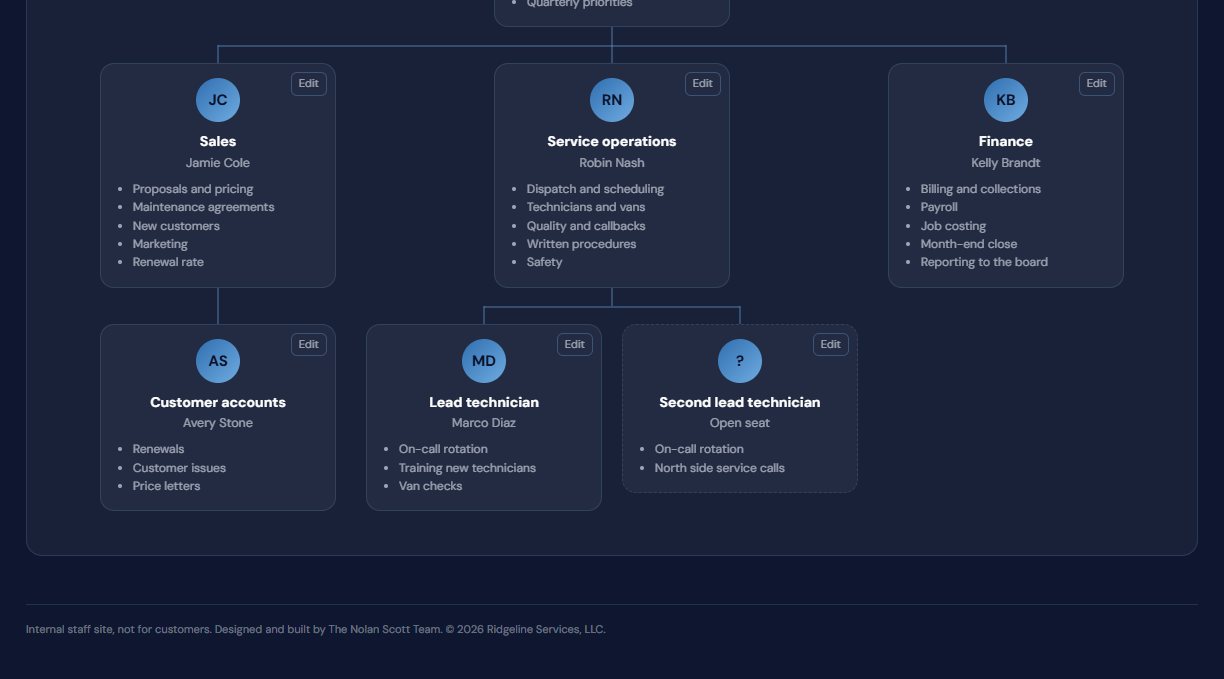
- Five responsibilities. The five outcomes the seat is responsible for. An operations seat in a sweeping company might read: routes and crews, fleet, quality of service, call-outs, safety.
Five is a working limit. Fewer and the seat is vague enough that two people can each assume the other one has it. More, and the seat is usually two jobs that happen to belong to one person today. When an owner cannot get a seat down to five, that is often where a new seat belongs.
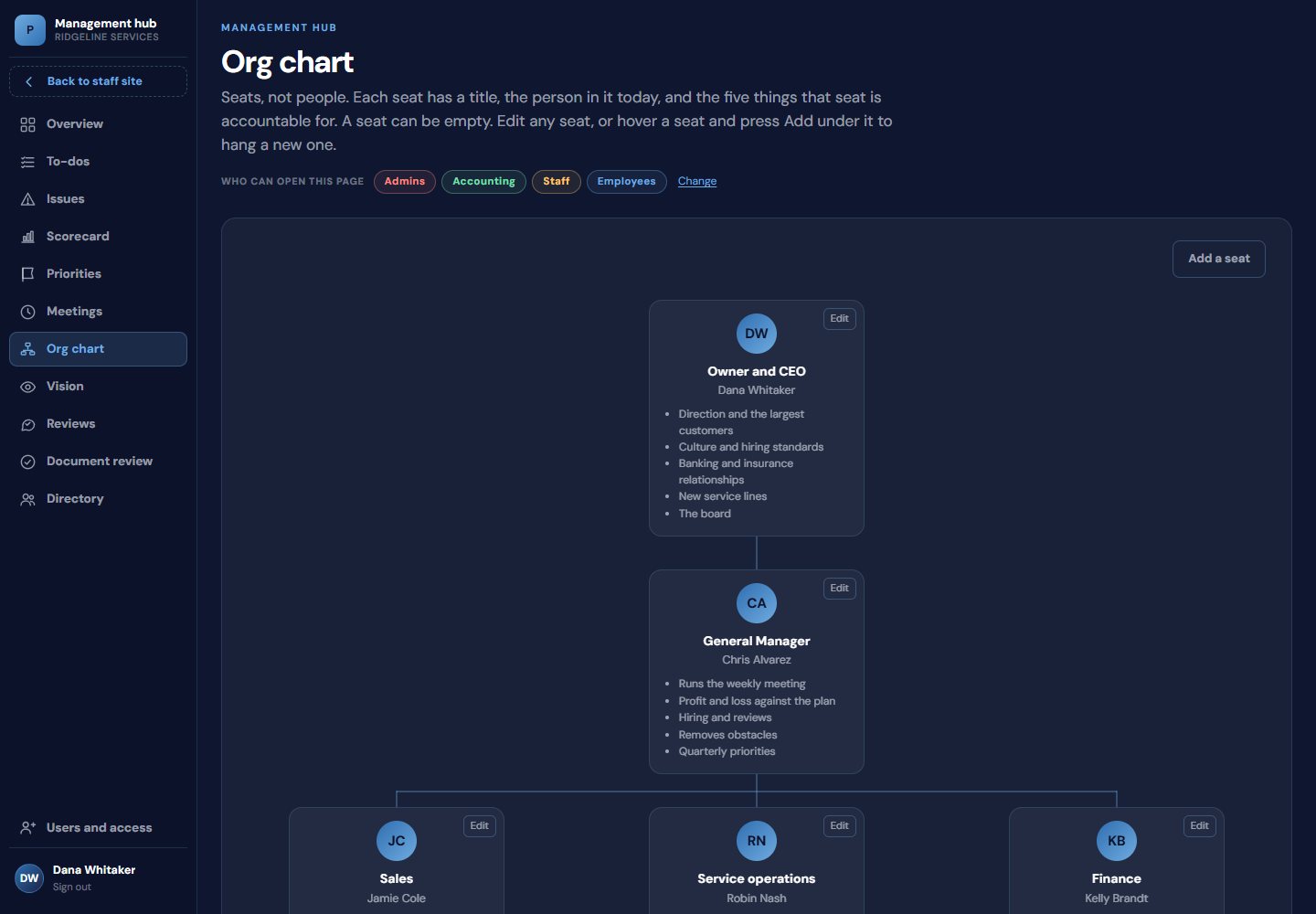
Only now write in the names. On Prime's staff site each seat shows the person in it today, a seat can be edited in place, and a new one is hung under an existing seat with one button. An empty seat shows as empty, which is the point. The chart is honest about the jobs nobody is doing yet.
The finding: your name in more than one seat
When I draw this chart with an owner, the useful moment comes when the names go in. The owner's name lands at the top, as expected. Then it lands in sales, because the owner still writes the proposals. Then in finance, because the owner still approves every bill and reads the bank balance every morning. Sometimes in operations too, because the owner is the one the crew calls when a truck breaks down.
That page is the finding. It shows, in a form a buyer and a lender can read in a minute, exactly which seats leave the building on closing day. It is also a more accurate picture than the one many owners carry around, because it is built from responsibilities. An owner who says the operations manager runs operations will often find, writing out the five responsibilities, that two of them still come back to the owner every week.
Write the finding down as it is. The chart is only worth showing a buyer if it was true when you drew it, and the version with your name in four seats is the one you need to work from.
Job descriptions, numbers and the directory hang off the seats
A seat on a chart becomes something a buyer can check when the rest of the company's paperwork points at it. At Prime, four things hang off the seats.
Job descriptions. The company's documents library carries a job description for each field role: sweeper operator, sweep supervisor, day porter and fleet mechanic. Each new hire signs theirs along with the employee handbook, so the description of the seat and the person's signed understanding of it are the same document. When a job description and a seat's five responsibilities disagree, one of them is wrong, and it is worth finding out which before a buyer does.
Measurables. Every number on the scorecard has one owner and a goal, and that owner sits in a seat. The weekly and monthly numbers become the evidence that a seat is being run: green where the goal is met, red where it is not, with a trend line. Thirteen weeks of history on a number owned by someone other than the founder is exactly what a buyer asks to see. A measurable owned by nobody, or owned by the owner by default, points back to the same empty or doubled-up seat.
Written procedures. Each repeatable task gets a numbered procedure with an owner, and the owner is a seat. When the person in the seat changes, the procedures stay with the seat. I wrote about building that library in the written procedures a buyer expects to see.
The directory. Everyone in the company and every outside partner, by group, with a search box: board and leadership, operations, sales and accounts, accounting, and the outside partners. It answers the everyday version of the same question the chart answers, which is who handles this and how to reach them, without calling the owner to ask.
A plan for filling the owner’s seats before a sale
The chart with your name in several seats turns into a plan by working through those seats one at a time. The order we use:
- List every seat with the owner's name in it. Include the ones you share with someone, because shared seats are where responsibility goes missing.
- Rank them by what a buyer will ask about first. Usually that is whichever seat holds the customer relationships and the pricing, because that is where the earnings come from.
- Write the seat down before anyone else sits in it. The five responsibilities, the procedures behind them and the numbers that show the seat is working. A person cannot take over a job that exists only in your habits.
- Decide promote or hire. Sometimes the person already doing half the seat is ready for all of it. Sometimes the seat needs someone from outside, and the job description tells you who to look for.
- Hand over the numbers along with the seat. The measurables move to the new person's name on the scorecard the same week the seat does.
- Let it run before you go to market. A seat filled the month before listing is a promise. A seat filled a year before, with a scorecard history under someone else's name, is a record.
That last step is why this work belongs one to three years before a sale. Filling a seat is quick. Building the history that proves it is filled takes as long as it takes. It is also the work at the center of our advisory track: a fractional Chief Strategy Officer working the gap list with the owner, described on our consulting page. If you later sell with us, what you paid in advisory is credited against the closing fee, up to half of that fee.
You will probably keep one seat until closing, often the top one. That is normal. What a buyer needs to see is that the seat the owner keeps is the only one that changes hands with the owner.
Reviews that hold a person against a seat
A chart only stays honest if someone checks the people against it. At Prime, the management hub keeps a quarterly review for each person, held against their seat: the five responsibilities, the numbers that seat owns and the company's values. The history is kept per person, so a manager can see how the last four conversations went before starting the next one.
Holding the review against the seat changes the conversation. It is about whether the job the company needs is getting done, which is easier for both people to talk about than a general sense of how someone is doing. When the answer is no, the review usually points at one of three causes: the person is in the wrong seat, the seat is badly defined, or the seat is carrying more than five things. Each has a different fix, and the chart shows which one applies.
Reviews also give a buyer something the chart alone cannot. A record of quarterly conversations tied to written seats says the company manages its people the same way whether or not the owner is in the room.
Where to start
You can do the first version of this on a sheet of paper this week: draw the seats the company needs, write five responsibilities under each, then write in the names and count how many times yours appears. You can see the org chart, the scorecard, the reviews and the directory as they run at Prime in the management hub walkthrough, on placeholder names and numbers. If you would like to go through your own chart with me and work out which of your seats to fill first, book a time here.