
A short review every quarter, one per person, held against the seat that person fills and the values the company says it runs on, gives an owner a steady record of who is doing the job and who is drifting. That record is what lets you keep good people on purpose and deal with a poor fit early, instead of waiting until a bad week makes the decision for you. The conversation takes three questions about the role, one about the values, and a written note that stays in the person's file. This article walks through how we run it at Prime Sweeping, an overnight parking-lot sweeping and day porter company in metro Atlanta, and a company I am a partner in. I built its staff site, including the page these reviews live on.
Why the once-a-year review breaks down
In the small service companies we work with, the annual review usually fails in the same few ways. It gets tied to pay, so both people spend the meeting negotiating a raise and nobody talks about the job. It covers twelve months, so the reviewer remembers the last six weeks and whatever went wrong most recently. And it slips. A busy season, a truck down, a customer complaint, and the review moves to next month, then next quarter.
The deeper problem is that the owner's opinion of each employee lives in the owner's head. It shifts with the week. A supervisor who had a rough Tuesday gets judged on Tuesday. A driver who is quietly excellent never comes up, because nothing about them is on fire. When the owner finally decides someone has to go, there is nothing written down to show the person was told, coached or warned, and when a good manager quits, nobody saw it coming because nobody asked.
Prime still has an annual performance review on its HR forms, used once a year and at any pay review. The quarterly conversation sits beside it and does a different job. It is about the seat and the values, it is short, and it happens four times a year whether or not anyone is asking for a raise.
What a quarterly review covers
Each review is one conversation between a person and whoever they report to, and it answers four questions.
- Does this person understand the role? Can they tell you what the seat is responsible for and how it is measured, in their own words?
- Do they want it? Are they choosing this work, or tolerating it until something else comes along?
- Are they able to do it? Do they have the time, the skill and the judgment the seat asks for, today?
- Do they live the company's values? Measured by what they did this quarter, with examples.
The first three are separate on purpose. Someone who grasps the role and has the ability for it but has stopped wanting it needs a different conversation from someone who wants it badly and is out of their depth. Lumping them into a single rating hides which problem you have. A no on any one of the three is worth writing down, because a no that shows up two quarters running is a pattern, and patterns are what the owner should be acting on.
That is the whole review. It fits in a half-hour, and most of the value comes from doing it every quarter for every person.
Reviewing against the seat
A review only works if there is something fixed to review against. At Prime that is the seat on the org chart. Each seat has a title, the person in it, who it reports to, and the five things it is responsible for. The five responsibilities are the job description in its shortest form, and they are what the reviewer reads out loud at the start of the conversation.
From there the reviewer walks down the five and asks, for each one, how the quarter went. The answer should come from the record, which is where the scorecard earns its keep. Every weekly measurable on the scorecard has one owner and a goal, with thirteen weeks of history in green and red. If the operations seat owns missed stops per night and the number was red for nine of the thirteen weeks, that belongs in the review, and nobody has to argue about whether it was a bad quarter. The same goes for quarterly priorities: each has an owner and a due date, and whether the person's priorities finished on track is a fact on the screen.
Reviewing against the seat changes the tone of the meeting. The question stops being whether the owner likes this person and becomes whether this person is doing the five things this seat exists to do. That is easier to hear and easier to act on. It also exposes the opposite problem: sometimes the person is fine and the seat is badly drawn, with seven responsibilities crammed into five lines or two seats sharing one outcome. I wrote about how seats are defined, and why an empty or overloaded seat is a risk a buyer will price, in the article on org chart seats and key-person risk.
Keeping the values part concrete
This is the part owners most often skip or water down, because values sound soft on paper. Many of the owners we meet have three to five words on a wall, and a review that asks "do you show integrity?" gets a yes from everyone and tells you nothing.
What keeps it useful is writing each value as a behavior somebody could see. "We finish the route" says more than "reliability." "We tell the customer before they find it" says more than "communication." Once each value reads as something a person did or did not do, the reviewer can go down the list and give one example from the quarter for each. If the reviewer cannot think of an example either way, that is worth noting too, because it usually means the reviewer does not know the person's work as well as they should.
The values question also catches a problem the seat questions miss: the strong performer who hits every number and is hard on everyone around them. The scorecard will never show that person as a problem. The values part will, and writing it down each quarter gives the owner a record that the issue was raised long before anyone's patience ran out.
Write it down and keep the history
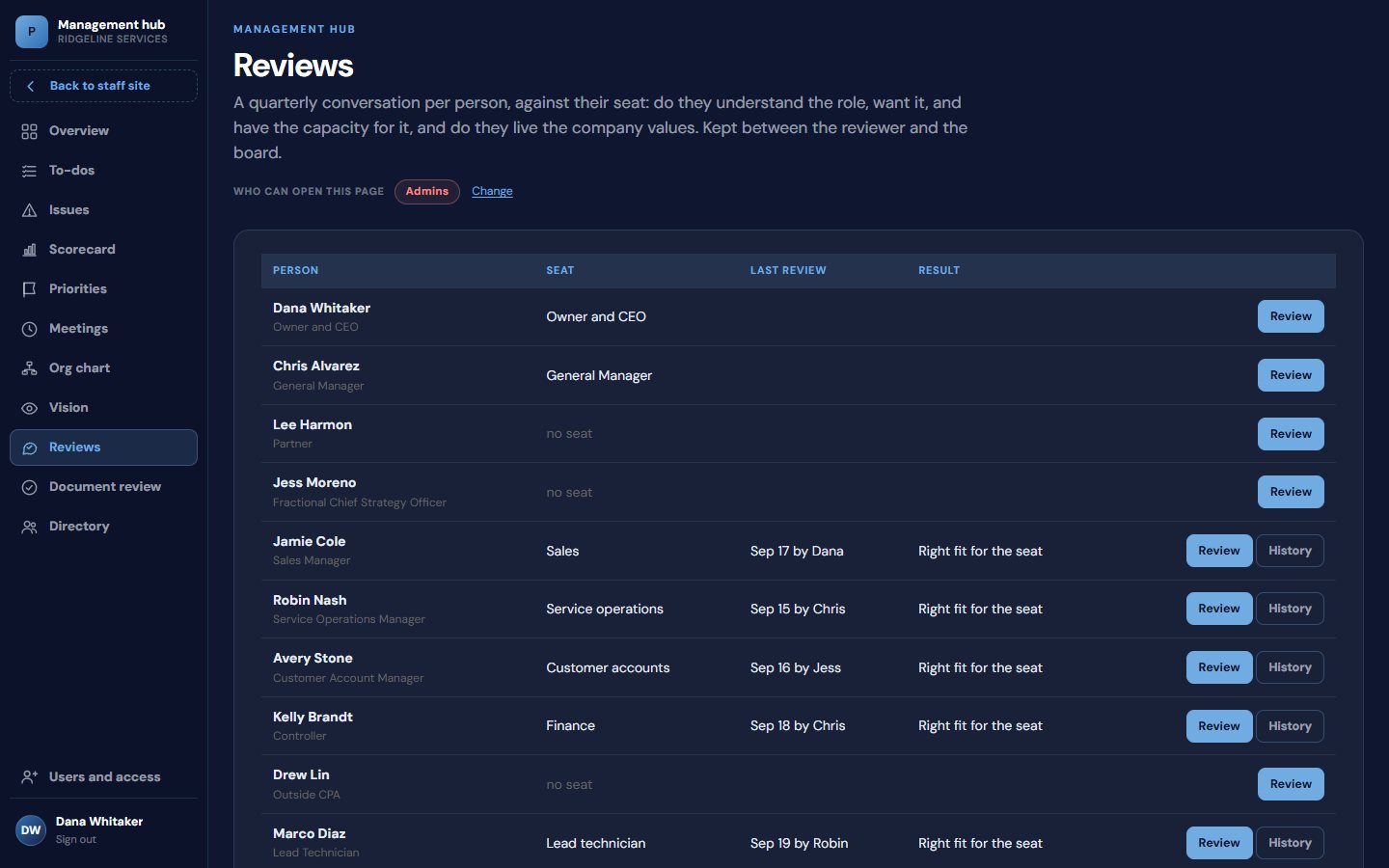
A review that is only a conversation is gone by the next quarter. At Prime every review is saved against the person, with the date, who gave it, the seat it was measured against and the result. The page lists everyone with their seat, their last review and its outcome, and the history for each person opens from the same row. It is visible only to admins, and what is said in it stays between the reviewer and the board.
Three things come out of keeping the history. First, you can see a trend. One weak quarter is a bad stretch; three in a row is an answer. Second, the reviews stop depending on who gives them. A manager who takes over a seat can read the last four reviews before their first conversation with the team. Third, the list itself shows gaps: people with no seat, and people who have never been reviewed, sit in plain view. That last point matters to an owner who is trying to step back, because the reviews keep happening when the owner is not the one running them, which is the same test a buyer applies to everything else in the company.
When someone falls short
The quarterly review is where a shortfall is first named, and the next step should never be improvised. At Prime the handbook sets the steps, and each step has a form built to match the handbook section it enforces.
It starts with coaching. A minor issue gets a coaching record: a first conversation, written down, that is explicitly not a warning letter. It says what the expectation is, what happened, and what the person agreed to do about it. Most shortfalls end there, and they end there because the conversation happened early, in a quarterly review, while it was still minor.
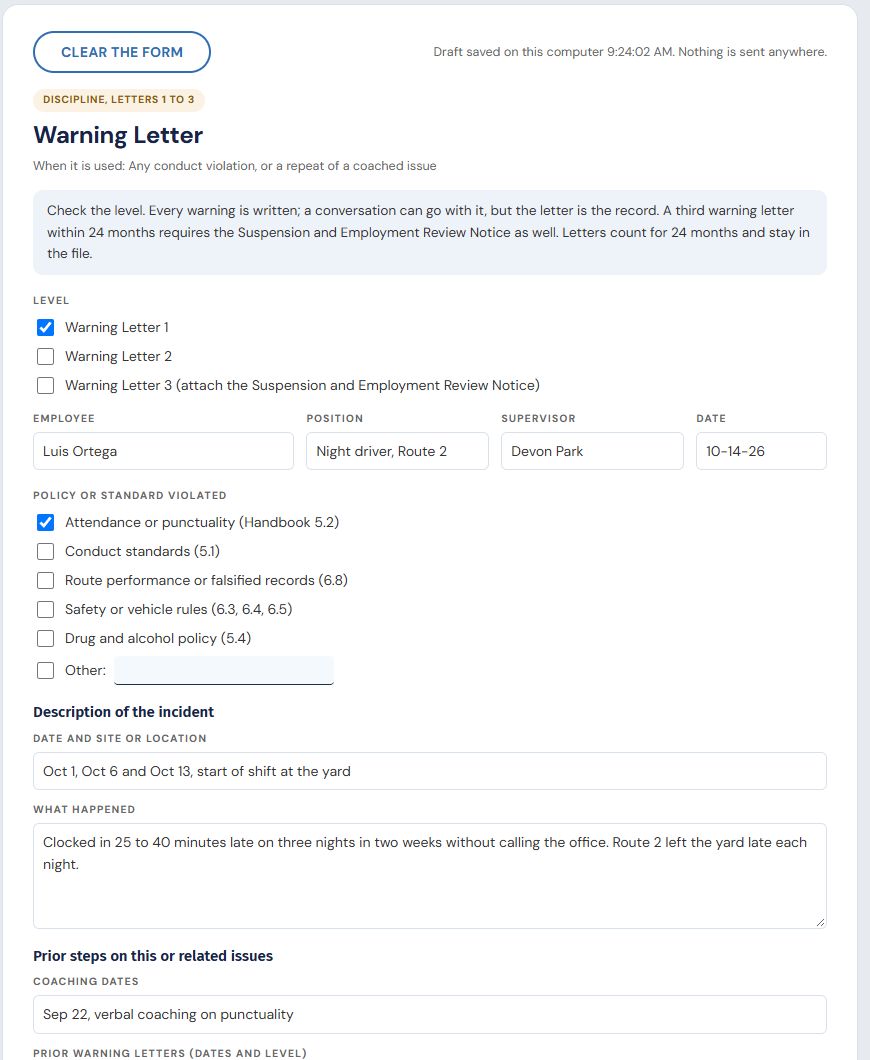
If the issue repeats, or if the conduct is serious to begin with, the handbook's discipline steps take over: numbered warning letters, then a suspension and employment review notice. Each warning letter records the level, the employee, the handbook section that was broken, what happened, and the prior coaching. Supervisors complete the forms, and an owner approves discipline before it is given, so the same situation gets the same response whoever the supervisor is.
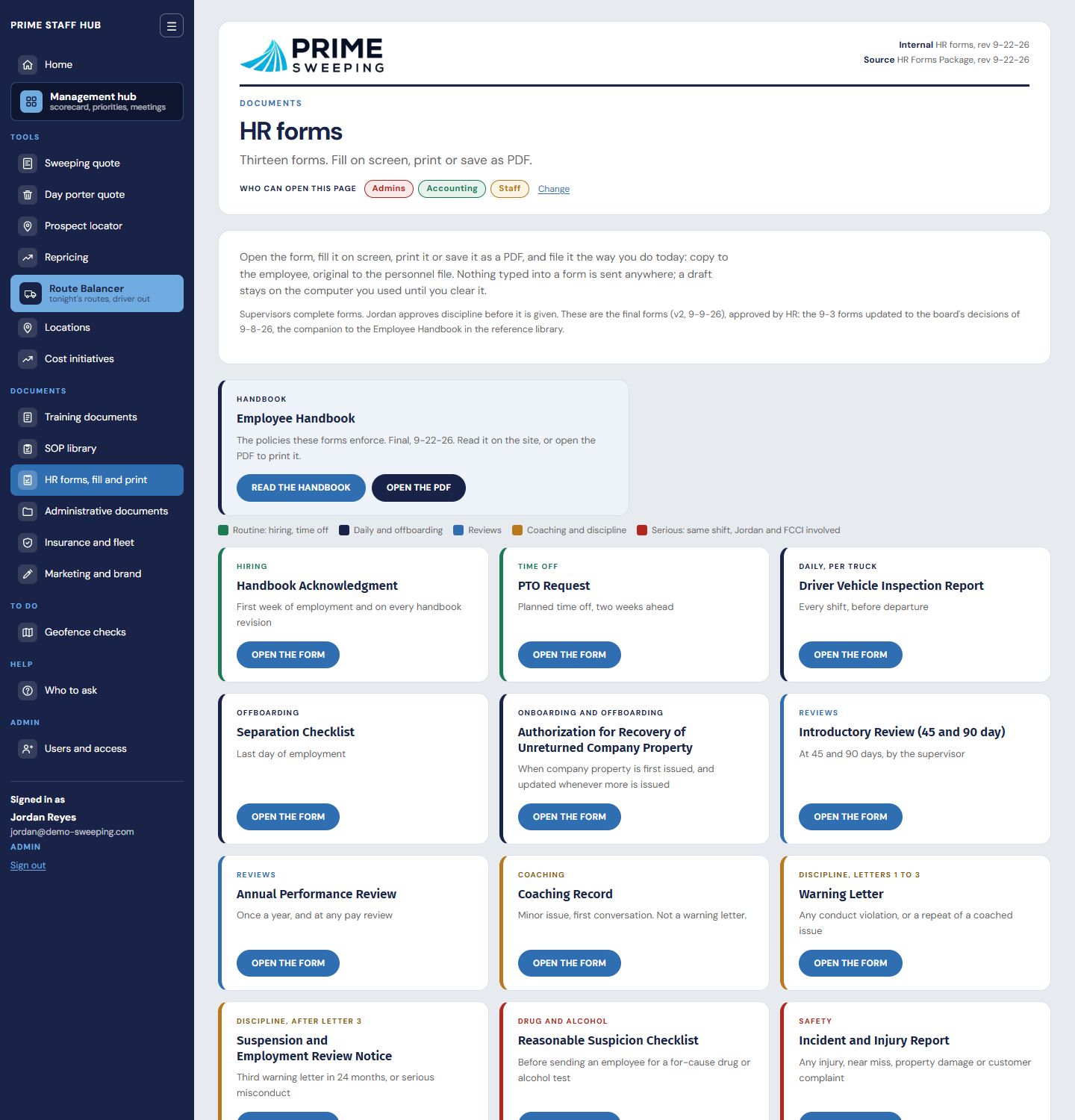
The forms are filled in on screen and printed, or saved as a PDF, for signature. The employee gets a copy and the original goes to the personnel file, the way the company already filed paper. Nothing typed into a form is sent anywhere. A draft stays on the computer where it was written until someone clears it. There are thirteen forms in the set, from the handbook acknowledgment to separation, and you can see how they are grouped on the What We Built page. The same logic behind them, writing down the way a task is done so it gets done the same way every time, is covered in the article on written procedures buyers expect.
The point of the chain is fairness and a clean record. When someone does have to leave, the file shows they were told what the seat required, coached, and warned in writing, and the decision does not rest on how the owner felt that week.
Why a buyer asks who stays
Of the four value drivers we name on this site, the largest is a company that runs without the owner day to day. The people in the seats are how that happens. A buyer looking at a service company will want to know who the key people are, what they do, and whether they are likely to stay after the sale. A buyer discounts a company that lives in the owner's head, and a company that lives in one manager's head carries a version of the same risk.
Quarterly reviews answer that question with a record. Two years of reviews for the operations manager, measured against a written seat and a scorecard with history, show a buyer that the person understands the job, has been doing it, and has been asked every quarter whether they still want it. That is a different conversation from an owner saying "he's great, he's been here forever." Key-person retention is one of the items we work on with owners who are one to three years from a sale, alongside written procedures and clean financials, because it cannot be manufactured in the months before a listing. On earnings of $850K, half a turn is over four hundred thousand dollars at closing, and it is the same business.
Where to start
You do not need software to begin. Write each seat's five responsibilities, write the values as behaviors, and hold one short conversation per person this quarter with notes kept in a folder. What a staff site adds is that it keeps happening when you stop pushing it: the list shows who is overdue, the history is one click away, and the forms match the handbook without anyone checking.
If you want help setting this up, or you are weighing whether your team would hold up in front of a buyer, that is the kind of work described on our consulting page. You can book a time with me here, and we can start with where your time goes today.