A buyer looking at your company wants to see how the work gets done without you. The clearest answer you can hand them is a library of written procedures: one for each repeatable task, numbered, sorted by department, each with a named owner, and each written well enough that someone hired last week could follow it on their first day. Next to it sit the HR forms that enforce your handbook and the documents that set the company's rules: the handbook itself, job descriptions, standard terms, who can decide what, and how prices are set. This article covers what that library looks like, how to write a procedure a new hire can actually use, and which ones to write first. The examples come from Prime Sweeping, an overnight parking-lot sweeping and day porter company in metro Atlanta, where we hold an ownership interest, a board seat and the Chief Strategy Officer role.
Why "it's all in my head" is a diligence problem
Buyers commonly ask some version of the same question during diligence: who does this, and what happens when that person is gone? When the honest answer to most of those questions is the owner, the buyer is being asked to purchase a company and then rebuild the person who ran it. A buyer discounts a company that lives in the owner's head, and that discount shows up in the multiple. On earnings of $850K, half a turn is over four hundred thousand dollars at closing, and it is the same business.
Of the four things we see move value most (a company that runs without the owner day to day, recurring or contracted revenue, no customer over 20% of revenue, and clean, reviewed financials), the first is the largest. It is also the hardest to prove. Telling a buyer "my team knows how to do it" gives them nothing they can check. A shelf of procedures with owners' names on them, a set of forms filled out the same way every time, and a handbook that matches both are things a buyer can read, and a lender can read too.
The same work pays off if you are not selling. Growth breaks whatever is informal. When the tenth hire learns the job from a written procedure, they learn the same job the first hire learned, and you stop being the person every question routes through.
What a procedure library looks like
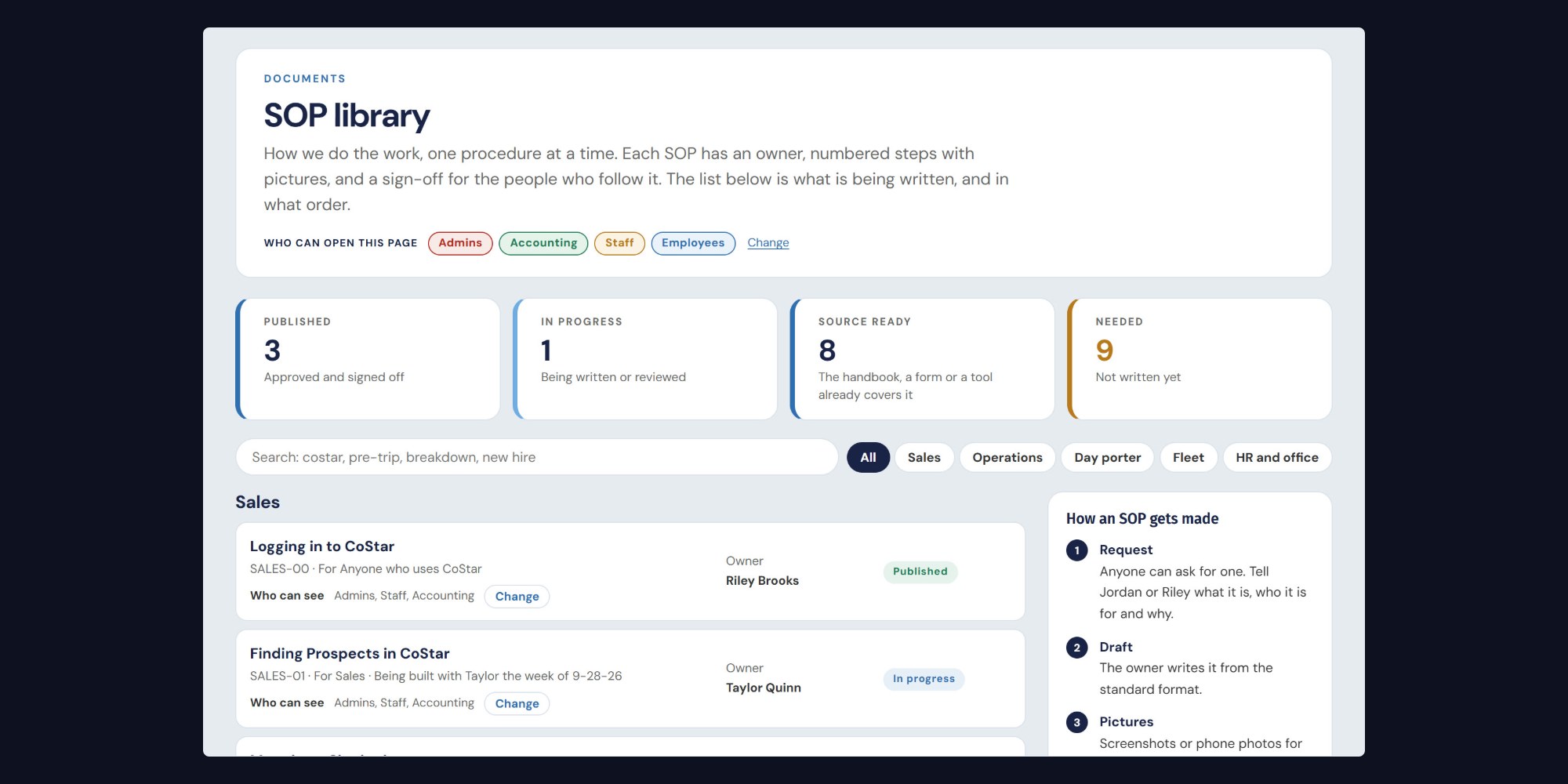
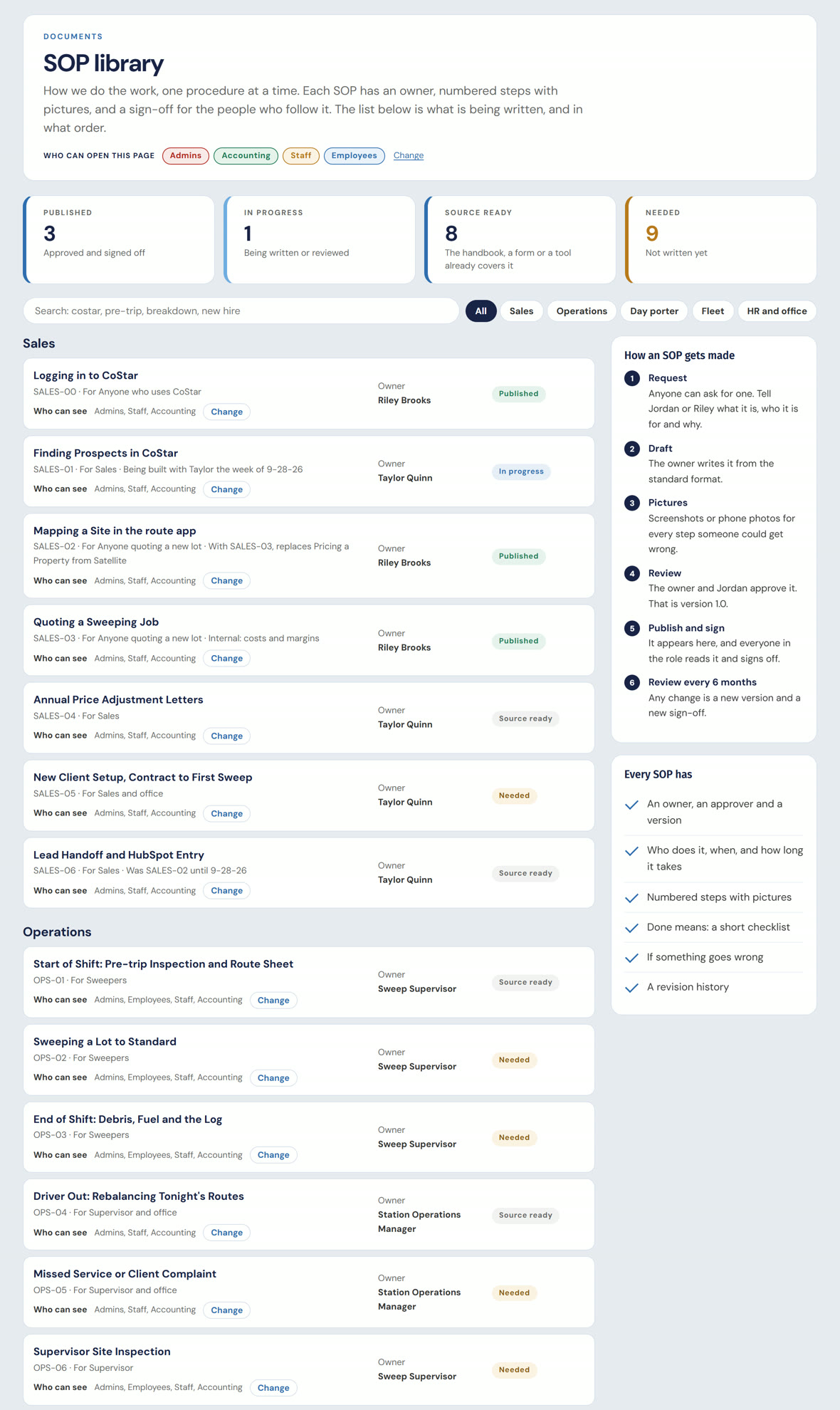
At Prime, the library is a single page on the company's private staff site, behind the same sign-in as the route tools and the management hub. Twenty-one procedures are mapped across five departments: sales, operations, day porter, fleet, and HR and office. Each one has a number, a title, an owner and a status, and three were published in the first weeks, starting with the ones sales uses every day.
The status is the part most owners skip, and it is the part that makes the library useful. There are four:
- Published. Written, tested and live. Anyone with access can open it and follow it.
- In progress. Someone is writing it now.
- Source ready. The raw material exists (a recording of the task being done, the screenshots, notes from the person who does it) and it is waiting to be written up.
- Needed. The task is real and repeatable, and nothing is written yet.
Mapping all twenty before most of them were finished was deliberate. The map is the list of every repeatable task in the company, with a name next to each. It shows you where the gaps are, and it shows a buyer that you know where they are. A library that shows how many are published, how many are left and who owns each one is more credible than one that pretends to be complete. Procedures are published as they are finished, so the page is never waiting on a big reveal.
How to write a procedure a new hire can follow
Most written procedures fail the same way. They describe the task at the level of someone who already knows how to do it, so they read fine to the author and are useless to anyone else. The format we use at Prime is built to prevent that.
Start with three facts
The top of every procedure answers three questions before the first step: what the task is for, who does it, and how long it takes. The purpose tells the reader why the steps matter, which helps when something on screen does not match the picture. Who does it ties the procedure to a seat on the org chart. How long it takes tells a new hire whether they are going at the right pace, and tells a manager how to plan the day.
Numbered steps, one action each, with a screenshot
Then the steps, numbered. Each step is one action. Each step has its own screenshot, marked where to click. That last part does most of the work: a new hire follows the pictures, and they do not have to call someone to ask which button the procedure meant. Blur anything that should not be copied around, such as login details.
Write it from the way the task is actually done
Sit with the person who does the task today and have them do it while you capture each screen. Write down what they actually do, including the workaround they use because the software has a quirk. A procedure written from how the task is supposed to go will be wrong on the first day someone uses it, and after that nobody trusts the library. If the real way is bad, fix the process first and then write the fixed version down.
Test it on someone who has never done it
Hand the draft to a person who has never done the task and watch them work through it without helping. Every question they ask is a missing step or a missing picture. Add it, and try again with someone else if you can. When a stranger can finish the task from the page alone, mark it published.
Make it printable
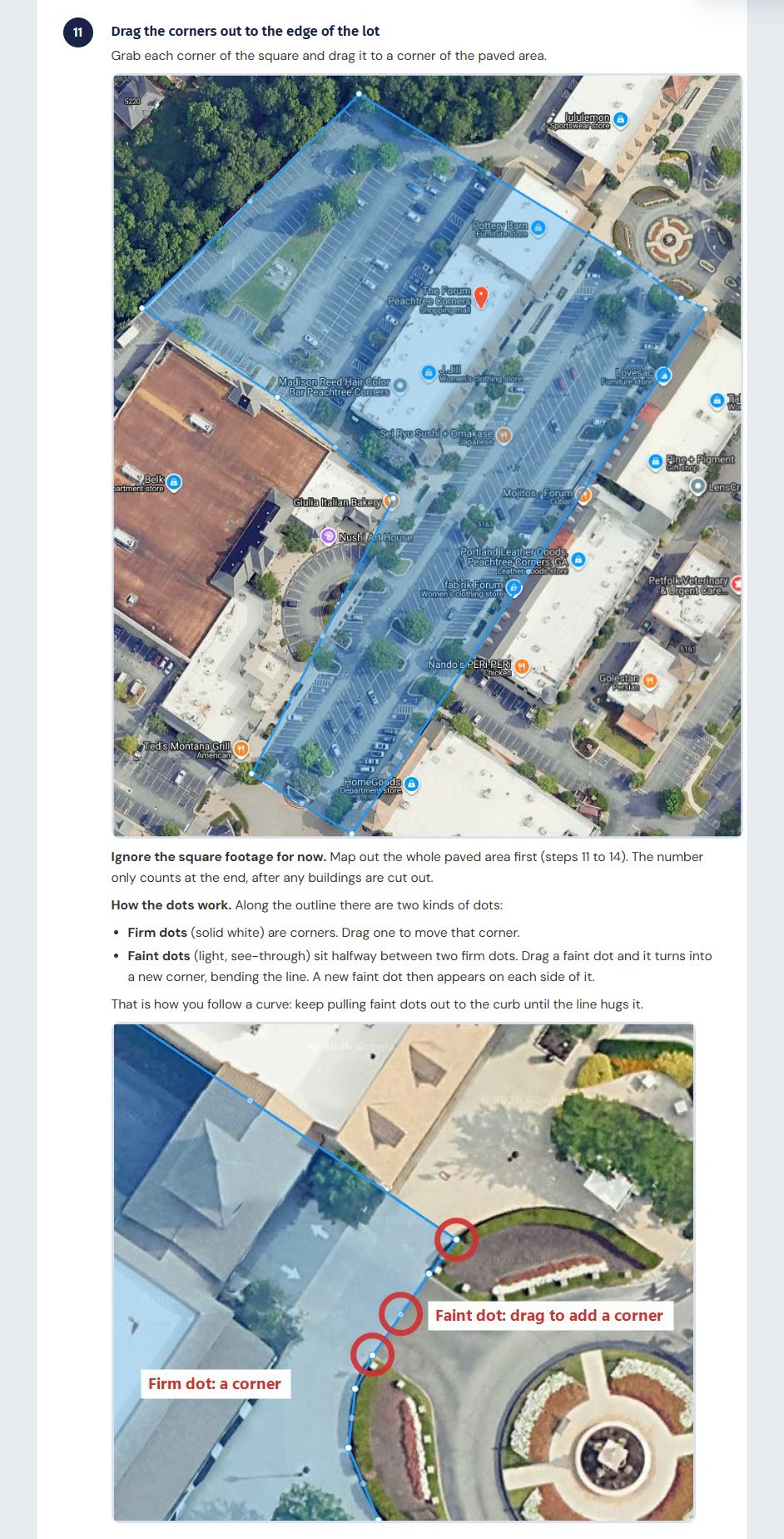
Every finished procedure at Prime prints as a PDF. That matters on a job site with no signal, in an onboarding binder, and in a data room when a buyer asks what you have. The picture below is from one of Prime's published procedures, mapping a new lot: the salesperson traces the pavement on a satellite picture to get the square footage the quote needs. You can see more of the library in the written procedures section of What We Built.
Which procedures to write first
With twenty or more tasks on the map, order matters. Start with the tasks only one person can do, and specifically the ones that go wrong when that person is out. Those are the tasks carrying the most risk, and they are the ones a buyer will find first, because they will ask.
A few questions surface them quickly:
- What went wrong the last time someone was on vacation or out sick?
- What do you, the owner, get called about at night or on the weekend?
- Which tasks would stop entirely if one particular employee quit tomorrow?
- Which tasks happen rarely enough (monthly, quarterly, once a year) that nobody remembers the steps?
At Prime, the clearest example was the nightly routing: for years the night depended on the one person who knew every lot by heart. That knowledge now lives in a working tool on the staff site, which anyone trained on it can run. Your version will be different, but it will have the same shape: knowledge that sits with one person and has no backup.
Leave for last the frequent, simple tasks that everyone already does well. They still belong on the map, marked needed, so they are not forgotten, but writing them first feels productive while leaving the real risk in place.
HR forms matched to the handbook
A handbook says what the rules are. Forms are how a manager applies them. When the two are not connected, each manager handles a late arrival, an injury or a warning in their own way, and the company's records end up as inconsistent as the handling was.
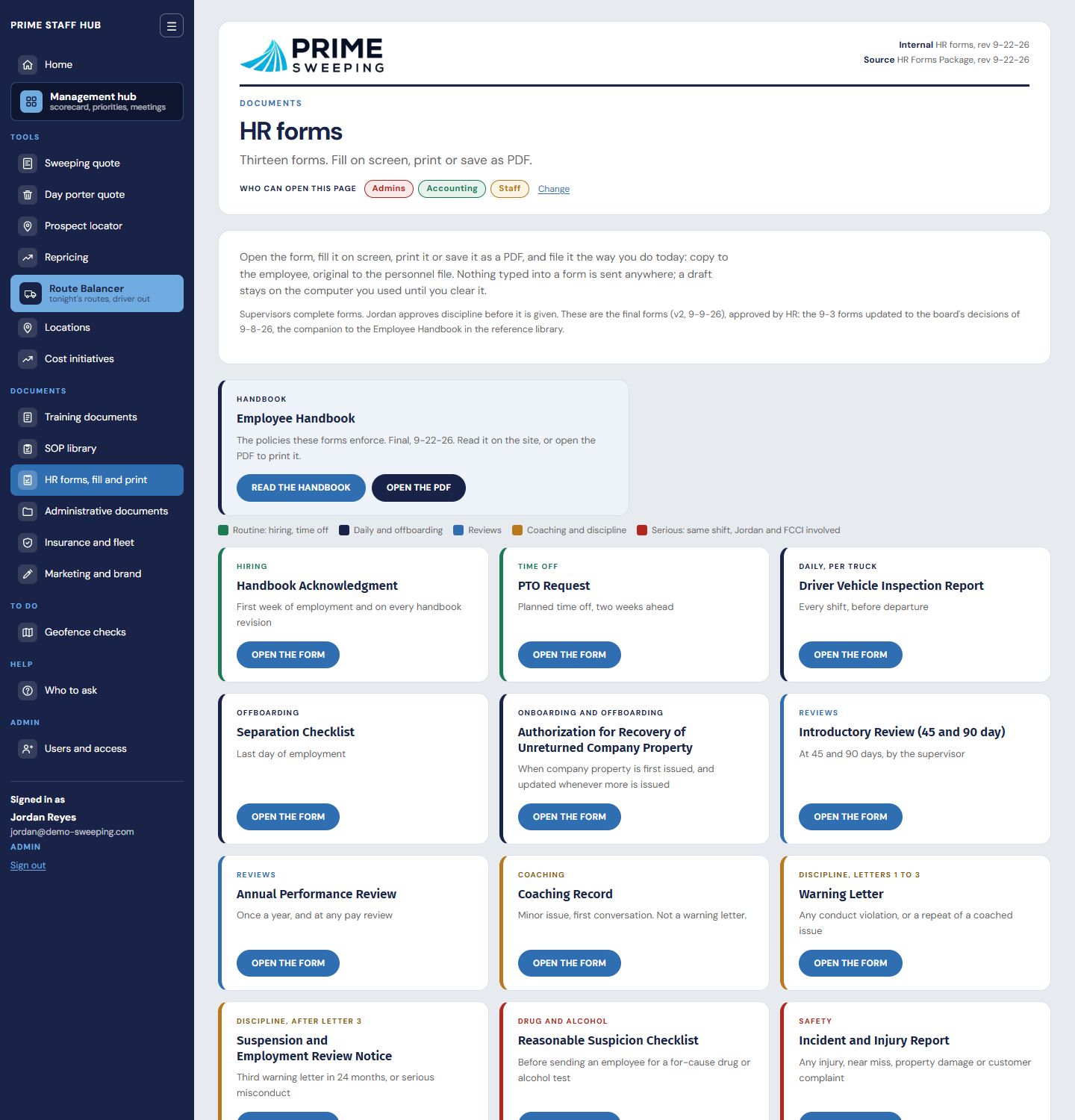
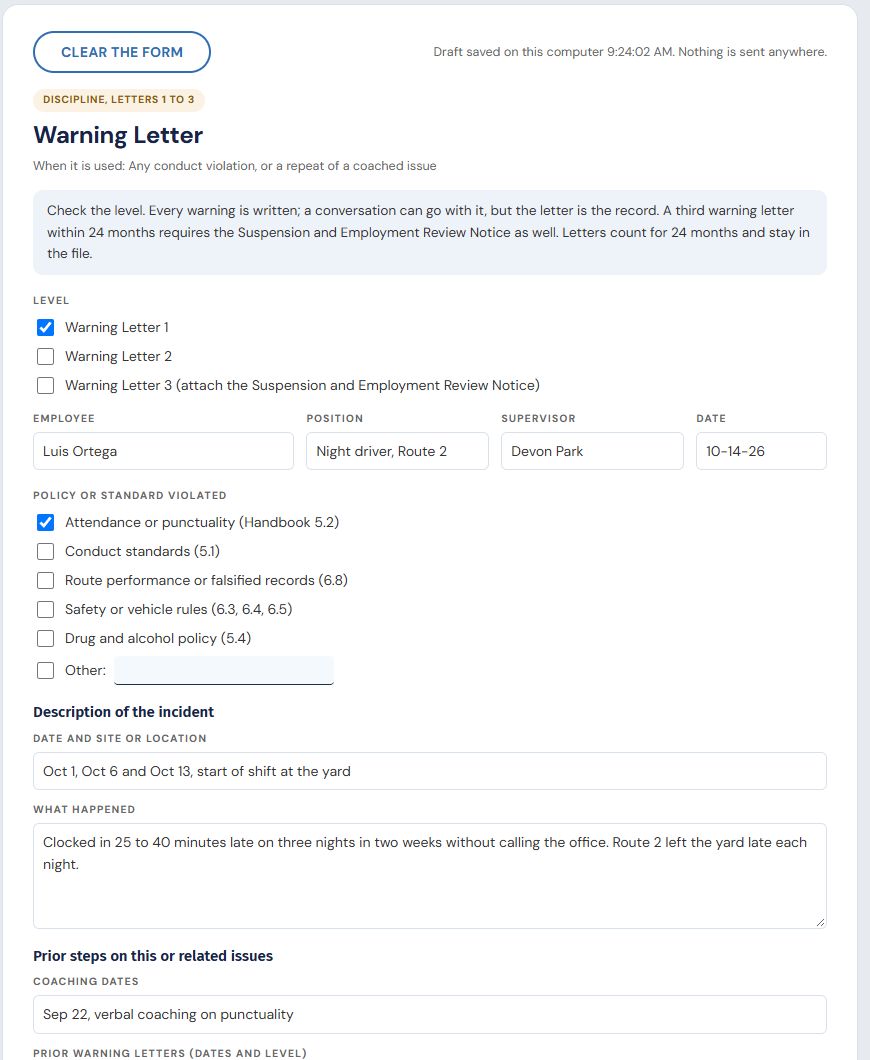
Prime's staff site carries thirteen HR forms: handbook acknowledgment, time off, vehicle inspection, incident and injury, vehicle accident, coaching, warnings, suspension, reviews, property recovery and separation. Each form matches the handbook section it enforces. A warning letter, for example, asks for the level of the warning, the employee, the handbook section that was broken, what happened and the prior coaching. The manager fills that in on screen, prints it or saves it as a PDF for signature, and a draft stays on that computer until it is cleared. The index groups the forms from routine to serious, with the handbook one click away.
The effect is that a manager does the right thing the same way every time, whether it is their first month or their fifth year. When a buyer asks about employee matters, you can show them a file of forms completed in the same format under the same handbook sections, which is a much easier conversation than reconstructing events from memory. The full set is in the HR forms section of What We Built.
The company documents a buyer asks for
Beyond procedures and forms, buyers commonly ask for the documents that define how the company is run. The ones we put in front of them are:
- The employee handbook, current, with acknowledgments on file.
- Job descriptions for every seat, matched to the org chart.
- Standard terms: the contract terms the company uses with its customers.
- Who can decide what: a written list of which decisions a manager can make, which need a partner, and which need the board. This is the document that shows a buyer the owner is not the only person who can say yes.
- The pricing process: how a job is priced, from what inputs, against what target, so a new salesperson prices a job the way the owner would.
At Prime, fourteen documents sit in one library, in groups: getting set up, people, governance, the pricing model and contracts. The sales and repricing playbooks and the annual price letter live there too. Internal documents and client-facing documents are kept apart, and each one opens inside the site, ready to print. The point is less the number than the location. When everything a buyer might ask about lives in one searchable place, the diligence request list becomes a matter of printing, and the answers match each other because they were written to.
Where this fits in our work with owners
Written procedures, matched forms and a single document library are a core part of what we build for owners who are one to three years from a sale, or who want to grow without every decision running through them. It is the gap list we work through as a fractional Chief Strategy Officer, described on our consulting page. If you later sell with us, the advisory fees are credited against the closing fee, up to half of that fee.
Prime is the working example. The full What We Built showcase walks through the staff site screen by screen, on sample data.
Start with the list
You do not need software to begin. Write down every task in the company that only one person can do, put a name next to each, and mark which ones broke the last time that person was out. That list is the first page of your procedure library. If you would like to talk through it, or through what a buyer would make of your company today, book a conversation with me.