
A company's direction belongs on one written page that the owners edit and everyone on the team can read. That page covers five things: why the company exists and what it is best at, a long-range target, what sets it apart, a three-year outlook and a one-year plan. The quarter's priorities are then chosen against the one-year plan, so the work people do this month traces back to something written down. A buyer reads the same page in diligence, because it shows where management thinks the growth is, and the financials show whether the numbers support it.
Direction that lives in one head cannot be delegated
In many owner-operated companies the plan exists. It is just in the owner's head. The owner knows which customers to chase and which to let go, where the next route or crew should go, and what the company should look like in three years. The managers find out one decision at a time, usually when they bring a question and get an answer.
That arrangement works until the owner wants to step back. A manager cannot make a call the owner would make without knowing what the owner is aiming at. So every decision that touches direction (take this account, open that area, hire ahead of the work or wait) comes back up the chain. The owner stays the bottleneck, and the company's ability to run on its own stops at the edge of what has been explained out loud.
Writing it down is the fix, and it is a small one. The owners put the direction on a page. The team reads it. From then on, a supervisor weighing whether to take a job forty minutes outside the service area can check it against the page instead of calling the owner. That is the same test a buyer applies to the whole company: whether it runs without the owner day to day, which is the single largest driver of what the business sells for.
Five sections, and what each one is for
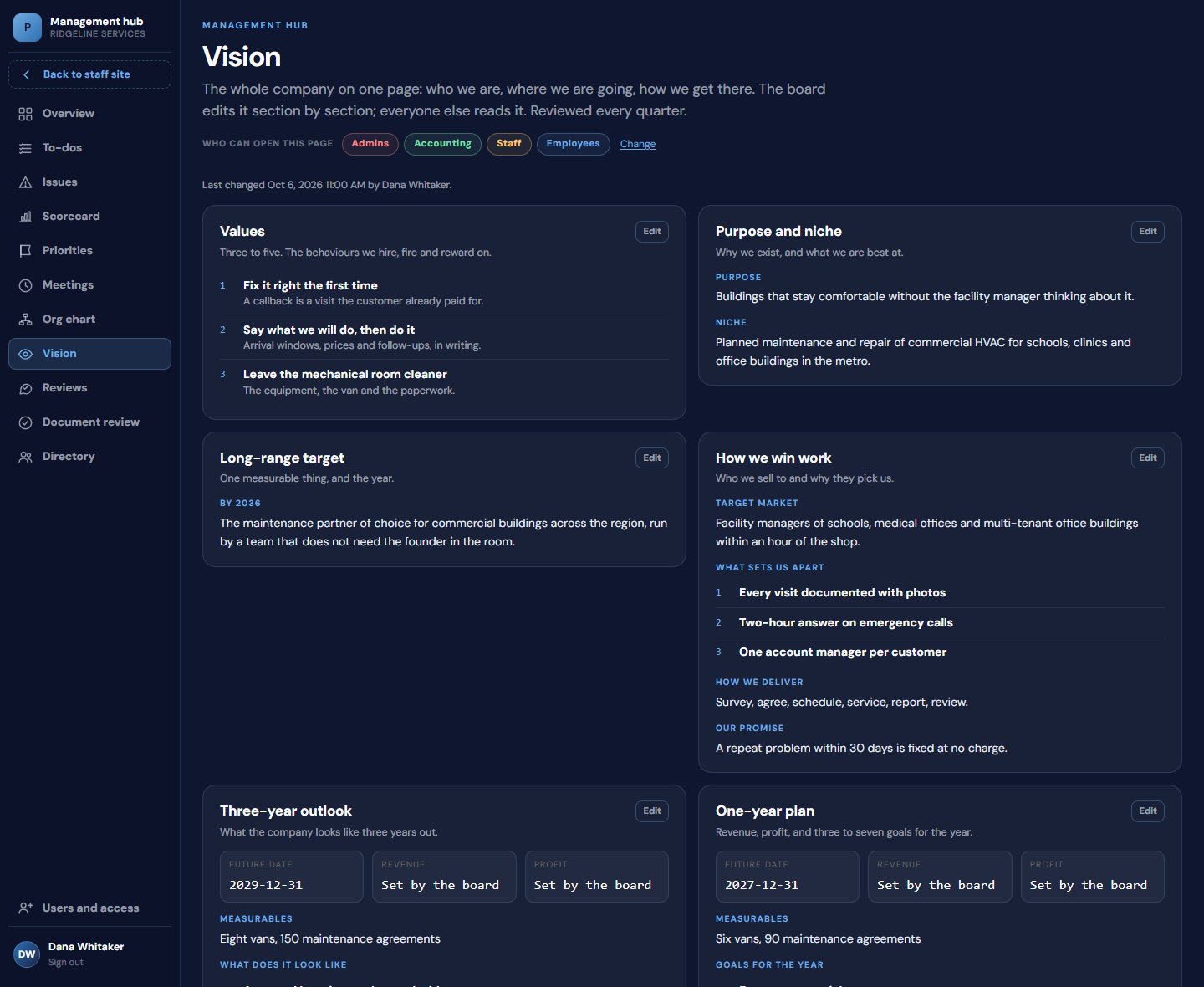
At Prime Sweeping, an overnight parking-lot sweeping and day porter company in metro Atlanta and a company I am a partner in, the written direction sits on a Vision page in the management hub I built for them. It has the sections below. The example lines here are generic, written for a made-up route-based service company, so you can see the level of detail each section wants.
Purpose and niche
Why the company exists, and the narrow thing it does better than anyone else. This section is the filter for every opportunity that is almost a fit. A route-based service company might write: "We keep commercial properties presentable every morning. Niche: recurring overnight service for property managers within a set drive of our yard." The niche line does most of the work. It tells a salesperson which calls to return first.
Long-range target
One measurable thing, and the year it is due. It should be far enough out that it cannot be reached by working harder this year. "By 2035: routes running in three metro markets, each under its own manager." A target like that tells the team the company intends to grow past one location and past the founders, and that shapes who gets hired and trained now.
What sets you apart
Three things a customer can check, stated plainly. Slogans do not belong here. "Every visit logged with a time stamp. One named contact who answers the phone. Prices built from measured time on site." If an item cannot be verified by a customer, it belongs somewhere else. This is also the section a new salesperson learns first, because it is what they will be asked about.
The three-year outlook
What the company looks like on a specific date three years out: a revenue figure, a profit figure and a few measurables that describe the shape of the business. "December 31, 2029: twelve routes, a second yard, an operations manager running dispatch." The owners set the revenue and profit figures. The measurables are what make it readable to people who never see the financial statements.
The one-year plan
The same thing at twelve months, with three to seven goals for the year. "Hire and train a route supervisor. Move every customer onto written terms. Bring no single customer above 20% of revenue." This is the section the team works from most often, and it is where the owners can aim the year directly at the things a buyer pays for: owner independence, contracted revenue, customer concentration and clean books.
The page at Prime also opens with a short list of company values, the behaviors people are hired and reviewed on. Those are worth writing down too, but the five sections above are the ones that carry direction.
Why it has to fit on one page
The page is short so that people read it. A forty-page strategic plan gets written once, presented at an off-site and filed. One page gets opened before a quarterly session, glanced at when a strange opportunity comes in, and handed to a new manager in their first week.
Short also forces choices. If the niche takes a paragraph, the company has not picked one yet. If the one-year plan has twelve goals, the owners have not decided which ones matter, and the team will pick for them. Keeping each section to a few lines is the discipline that makes the page worth having. When a section will not shrink, that is usually the conversation the owners need to have.
Detail still has a home. The pricing model, the hiring plan and the procedures each live in their own documents. The vision page points at them. It does not try to contain them.
The owners edit it, everyone reads it
Two rules keep the page trustworthy. Only the owners change it, and everyone can see it.
Editing is section by section. At Prime, each section has its own edit button, and the page shows who last changed it and when, so a change to the one-year plan does not quietly rewrite the long-range target along with it. The owners review the whole page every quarter. Most quarters, most sections do not change, and that stability is useful information in itself.
Reading is open to every tier of staff, from the partners to the newest employee. There is a reason to show the three-year outlook to a route driver. People make better small decisions when they know where the company is going, and they are more likely to stay when they can see a future in it with a seat for them. A plan only the owners can see is still a plan in the owners' heads, just typed.
Putting the page inside the same site the team already uses every day matters more than it sounds. Nobody has to find the latest copy in an email attachment. There is one version, one address and a date on it.
From the long view to this quarter's priorities
The page is only useful if it changes what people do on Monday. The link is the quarter's priorities. Each quarter, the leadership team picks three to seven priorities, each with one owner, a due date and milestones, and every one of them should move a goal in the one-year plan. The one-year plan, in turn, is a year's step toward the three-year outlook, and the outlook is a step toward the long-range target.
Written that way, the chain can be read in either direction. A manager looking at their own priority can see which annual goal it serves. An owner looking at the one-year plan can see whether anything this quarter is actually moving it. When a goal in the plan has had no priority against it for two quarters in a row, the plan and the work have drifted apart, and the page makes that visible.
We cover how the quarterly list is chosen and run in quarterly priorities for an owner-operated company. The short version is that the vision page is the input. Without it, the quarter's priorities tend to be whatever was most urgent in the last week of the prior quarter.
How a buyer reads it in diligence
When a company goes to market, a buyer wants to know two things the financial statements cannot tell them on their own: where management thinks the growth is, and whether management has been working toward it. The vision page answers the first directly. The three-year outlook says which lines, markets or services the team expects to grow. The niche says what the company has chosen not to chase.
The second answer comes from history. A page that has been edited and reviewed quarter after quarter, with priorities set against it each time, shows a management team that plans and follows through. A page written the month before listing shows a document written for the listing. Buyers can usually tell the difference, and in a management meeting they will ask the managers, not only the owner, what the plan says.
Then comes the caution. The page has to match the financials. A buyer will set it next to the tax returns and the monthly statements. If the three-year outlook calls for margins the company has never earned, or a growth rate well above anything in the last three years, the buyer will ask what changes to produce it, and a confident sentence on a page is not an answer. An outlook that stretches past the trailing results is fine when the path is written down: the routes that will be added, the hires that make them possible, the pricing work already under way. An outlook with no path reads as optimism, and it can make a buyer question the rest of the package.
The same goes for what sets you apart. If the page says every visit is logged and the buyer finds gaps in the service records, the page has done harm. Write down what is true today and what the company is actually building toward, and the page becomes one of the stronger exhibits in the file. How a buyer turns that confidence into a price is covered in what is my business worth.
Where to start
You can draft the first version of the page in an afternoon with your partners: write each section in two or three lines, argue about the ones that will not fit, and set a date to review it next quarter. The harder part is keeping it connected to the quarter's work and the numbers, and putting it somewhere the whole team reads it.
That is part of the work we do with owners one to three years before a sale, described on our consulting page. You can see the Vision page and the rest of the hub it sits in, screen by screen, in what we built for Prime Sweeping. If you would like to talk through what your own page would say, you can book a time with me here.