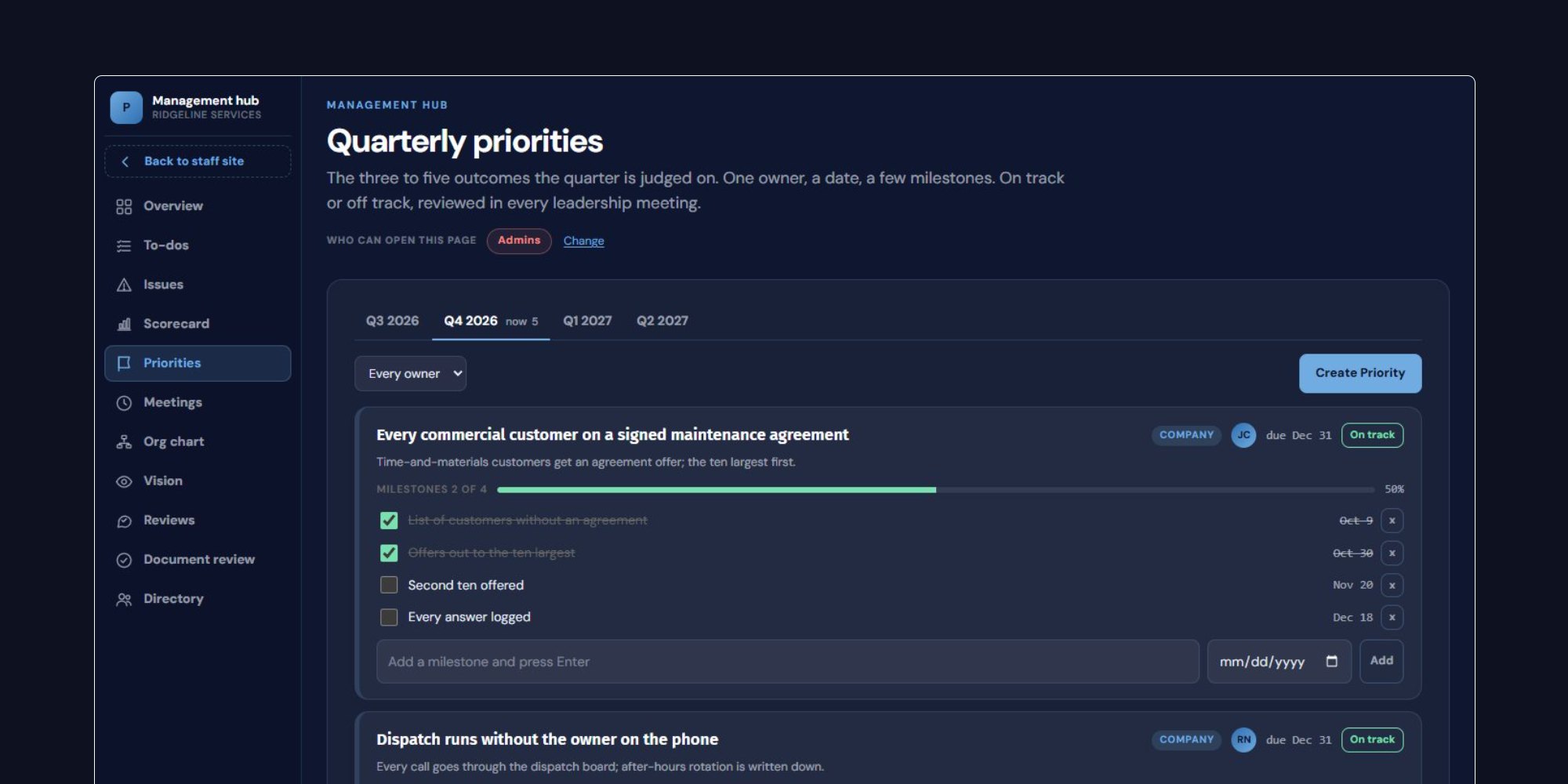
To set quarterly priorities so the quarter's work does not all sit with the owner, pick three to seven things the quarter will be judged on, choose them against the company's one-year plan, write each one with milestones and dates so anyone can check it, give each one a single owner, and keep no more than one or two for yourself. Then look at every one of them, on or off track, in every weekly meeting, and move any that slip onto the issues list. That is how we run the quarter at Prime Sweeping, an overnight parking-lot sweeping and day porter company in metro Atlanta. It is a company I am a partner in, and I built the staff site it runs on, including the management hub where the priorities live.
Why the quarter ends up on the owner's desk
In many owner-operated companies the owner is the only person who knows what the quarter is for. The goals are real, but they live in one head: finish the new route, hire a supervisor, get the books cleaned up before the bank review. Because nobody else has them written down, every one of them waits on the owner to start it, chase it and decide when it is finished. The owner ends the quarter exhausted and the team ends it having done their regular jobs well.
That pattern is expensive twice. For an owner who wants to grow, it caps the company at the number of projects one person can carry at once. For an owner planning a sale, it is the value driver buyers weigh most heavily, whether the company runs without the owner day to day, showing up on the wrong side of the ledger. A buyer discounts a company that lives in the owner's head, and that discount shows up in the multiple. Our article on how owner dependence lowers a sale price covers that part in detail.
Quarterly priorities fix the first half of the problem by putting the quarter's work on paper, with names on it, where the whole leadership team can see it.
Choosing the three to seven things the quarter is judged on
The test for a priority is simple: if this is done by the end of the quarter, will the owners call the quarter a success? Anything that fails that test is either regular work, which belongs on the scorecard, or a smaller task, which belongs on the to-do list. A priority is the handful of projects that move the company, and there should be few enough that the team can name them without looking.
Three to seven is the range the hub is built around. Fewer than three usually means the quarter has no ambition. More than seven usually means everything important got promoted to a priority, and a list where everything is urgent gets worked in whatever order the loudest customer dictates.
Priorities are chosen against something. In the hub, the Vision page holds the company's purpose and niche, its long-range target, what sets it apart, a three-year outlook and a one-year plan. The one-year plan is the list the quarter's priorities are picked from. If a proposed priority does not move a line of the one-year plan, it needs a good reason to be on the list, and the discussion about that reason is usually worth having.
For an owner planning a sale in the next one to three years, the one-year plan should itself be built around the four drivers that move a valuation:
- The company runs without the owner day to day. The single largest driver, and the one most priorities should serve.
- Recurring or contracted revenue. Customers on signed agreements are worth more to a buyer than customers who could leave next month.
- No customer over 20% of revenue. Concentration is a risk a buyer prices in.
- Clean, reviewed financials. Books a lender and a buyer's accountant can rely on without a rebuild.
A quarter that moves one or two of those drivers measurably is a good quarter, whatever else happened.
Writing a priority someone else can check
A priority written as "improve the night operation" cannot be checked by anyone, which means only the owner can say whether it is done, which puts it right back on the owner's desk. A priority has to be written so that another person, reading it cold at the end of the quarter, can answer yes or no.
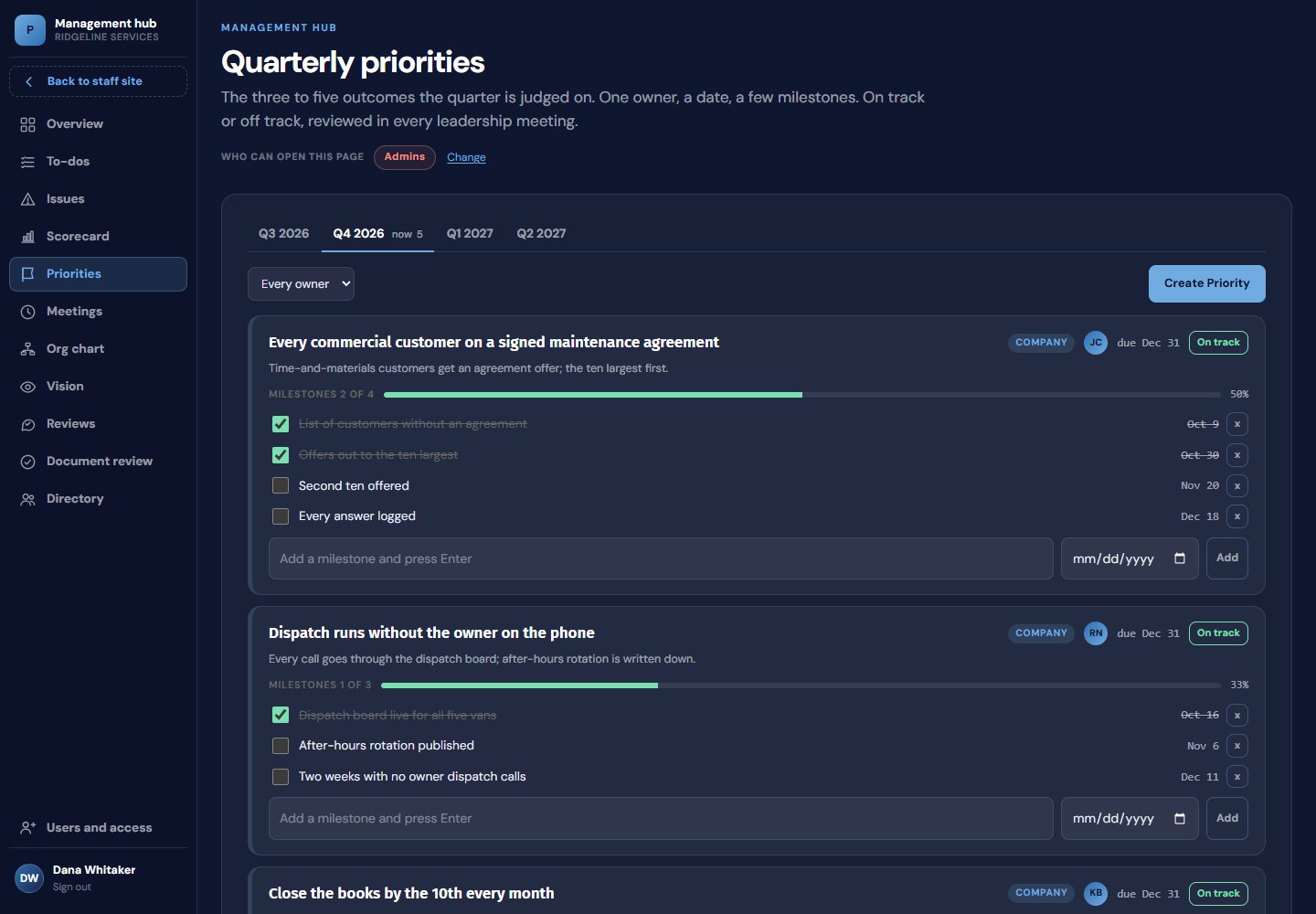
In the hub, each priority carries four things: one owner, a due date, a set of milestones and a progress bar that moves as milestones are completed. The milestones do most of the work. They break a quarter-long project into steps with their own dates, so that by week four you can see whether the project is where it should be, instead of discovering in week twelve that it never started.
Two generic examples for a route-based service company, written the way we would write them. These are illustrations, and they are not Prime's actual priorities.
- Every route can be run by a second trained driver by the end of the quarter. Milestones: list which routes have only one driver who knows them (week two); write a run sheet for each of those routes (week five); ride-along training completed for a backup driver on each (week nine); each backup runs the route alone once while the regular driver is off (week twelve).
- The ten largest accounts are on signed annual agreements. Milestones: agreement template approved by the owners (week three); renewal conversations held with all ten (week seven); signed agreements back from at least eight (week ten); the remaining two either signed or written up with a reason (week twelve).
The first one serves the owner-independence driver. The second serves recurring revenue. Both can be checked by anyone with a calendar and the file.
One owner each, and the owner holds one or two
Each priority has exactly one owner. A priority owned by two people, or by "operations", is owned by nobody, and when it stalls it drifts back to the company owner by default. The owner of a priority does not have to do all the work. They are the person who answers for it in the meeting, updates the milestones and raises it when it slips.
The harder rule is for the company owner: hold one or two priorities, no more. If the owner holds four of the six, the list has simply restated the old problem with better formatting. The owner's one or two should be the things only an owner can do, such as a banking relationship or a partner decision. Everything else goes to the person who will be running that part of the company when the owner steps back, even if that person needs help to get it done.
This is also where a thin org chart shows itself. If there is nobody to hand a priority to, the priority list has found an empty seat, and filling that seat may be the next quarter's first priority.
Seeing each person's priorities every week
A priority list that gets written at the start of the quarter and read again at the end is a wish list. The list has to be in front of the team every week.
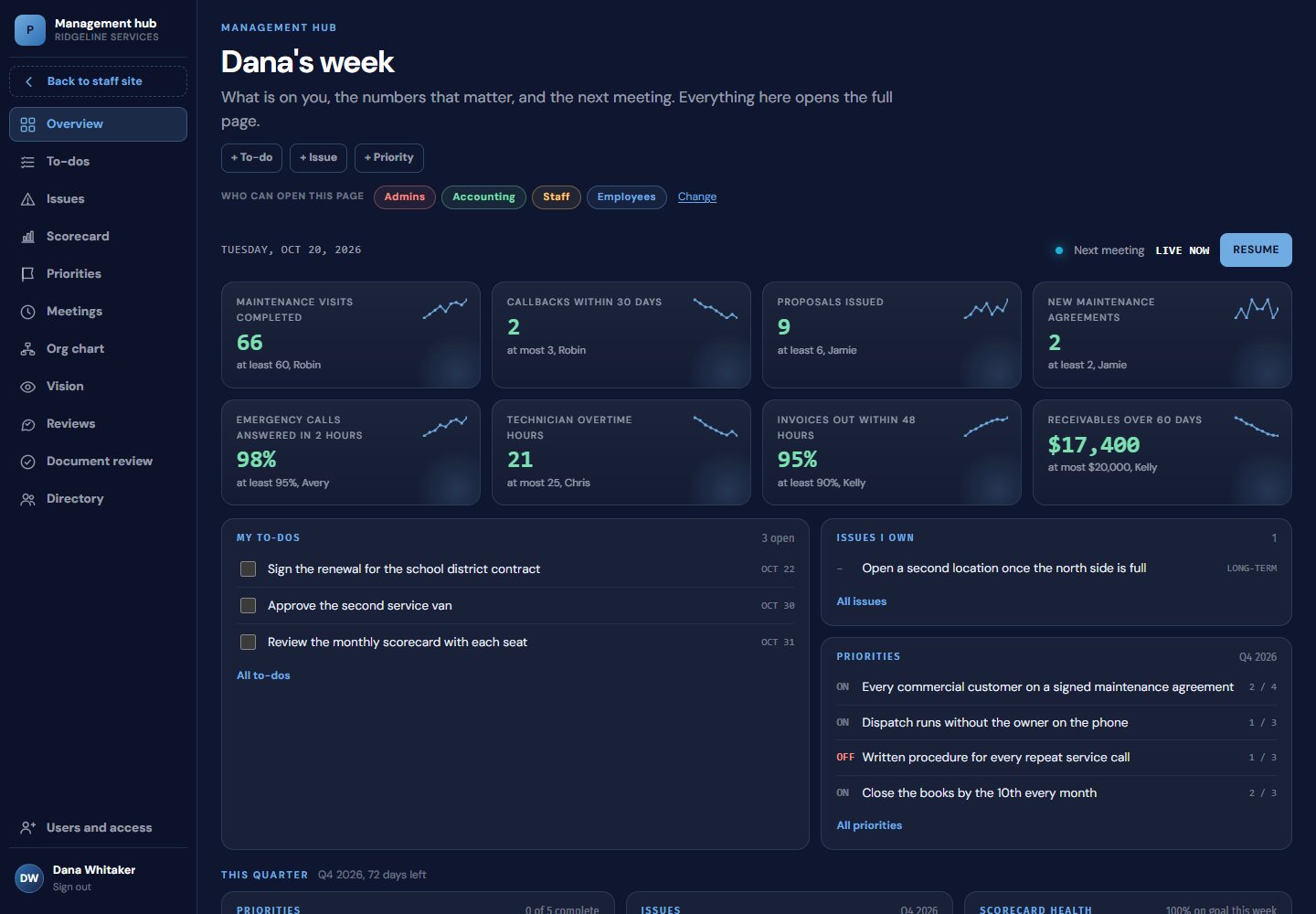
The hub does that in two places. The first is My week, each person's home screen: their scorecard numbers against goal, their to-dos, the issues they own, the quarter's priorities and a countdown to the next meeting. A manager opens the site and sees their own priority next to their own numbers, with the progress bar showing where it stands.
The second is the weekly leadership meeting. Every priority is shown on or off track in every meeting. The owner of each priority says one word, on track or off track, and the meeting moves on. There is no status report and no discussion at that point in the agenda, because discussion belongs in the issues section. We covered the full agenda in our article on running a weekly leadership meeting in a service company.
What happens when a priority slips
Priorities slip. A key hire falls through, a large customer's renewal gets pushed, a truck goes down for three weeks. The question is what the team does about it, and the answer should be the same every time: an off-track priority goes onto the issues list.
That moves it from reporting into problem solving. In the issues section of the meeting, the team works out what is blocking it, and the hub's Solve step turns the answer into a to-do with an owner and a date. Sometimes the fix is a milestone moved a week. Sometimes it is help from another manager. Sometimes the honest answer is that the priority will not finish this quarter, and it is better to know that in week six than in week thirteen.
What this avoids is the owner quietly taking the project back. In an owner-operated company that is the reflex: something slips, the owner steps in, and the manager learns that their priorities are provisional. Putting the slip on the issues list keeps it with its owner and makes the fix a team decision.
Closing out a quarter: done or not done, carry or drop
At the end of the quarter, each priority gets one of two answers: done or not done. Partly done counts as not done. That sounds harsh, but a priority written with dated milestones has a clear finish line, and scoring it honestly is what makes the next quarter's list credible.
For every priority that is not done, the owners make one more call: carry it into next quarter or drop it. Carry it if it still serves the one-year plan and the reason it missed has been dealt with. Drop it if the quarter showed it matters less than it looked, or if something more important now needs the same person. Dropping a priority on purpose is a decision. Letting it disappear from the list without comment teaches the team that priorities are optional.
Then the next quarter's three to seven are chosen, against the one-year plan again, with the carried items competing for a place like everything else. After a few quarters the company has a record: what it set out to do, what it finished, and who finished it. That record is useful to a buyer for the same reason thirteen weeks of scorecard history is. It shows a leadership team that plans and delivers without the owner holding every thread.
Where to start with your own quarter
You can set this up with a spreadsheet and a standing meeting, and many companies should start there. We built it into the management hub at Prime so the priorities, the scorecard, the issues and the meeting all live on one screen the team already uses. You can see those screens in What We Built, running on placeholder names and sample data.
If the quarter's work in your company still sits with you, and you are either planning a sale in the next few years or trying to grow past what one person can carry, that is the work our consulting practice does with owners. If you want to talk through your own list for next quarter, book a time with me.