A weekly leadership meeting makes a service company run without the owner in the room when four things are true: the same handful of numbers are reviewed every week, the quarter is judged on a short list of priorities that each belong to one person, every problem raised leaves the room as a to-do with an owner and a date, and the meeting runs on a timed agenda that anyone on the team can lead. That is the structure we set up at Prime Sweeping, an overnight parking-lot sweeping and day porter company in metro Atlanta, where the firm holds an ownership interest, a board seat and the Chief Strategy Officer role. This article walks through how it is built and why each piece is there.
Where owner dependence ends or gets reinforced
Plenty of owners already hold a weekly meeting. The question is what the meeting does. Often it is a status round: each manager reports to the owner, the owner makes the calls, and everyone leaves waiting on the owner to follow up. That meeting reinforces owner dependence every single week, because it trains the team to bring decisions to one person.
The other kind of meeting moves the decisions onto the team. The numbers are in front of everyone before the owner says a word. Problems are worked in the room and assigned before anyone leaves. The owner is one participant with their own to-dos, and if they miss a week, the meeting still happens and the numbers still get entered.
This matters twice. For an owner who plans to grow, it removes the bottleneck on every decision. For an owner who plans to sell, it goes straight to the value driver buyers weigh most heavily: whether the company runs without the owner day to day. A buyer discounts a company that lives in the owner's head, and that discount shows up in the multiple. On earnings of $850K, half a turn is over four hundred thousand dollars at closing, and it is the same business. Our article on what your business is worth covers how the multiple gets set.
A scorecard of a handful of measurables
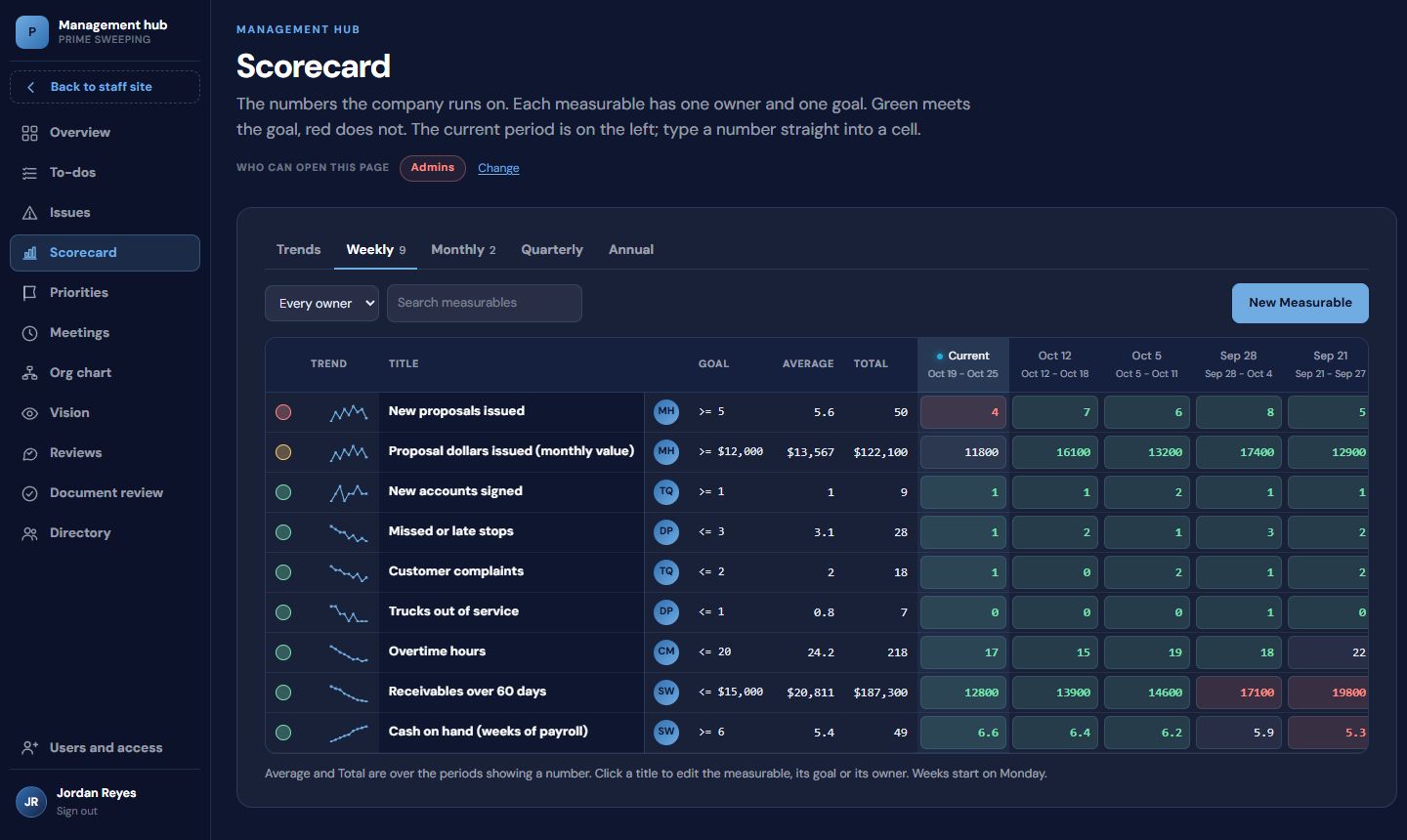
The scorecard is the first thing the meeting looks at. It is a short list of measurables, reviewed weekly, and each one has exactly one owner and one goal. Green means the number met its goal. Red means it did not. A sparkline beside each row shows the trend, so a number that has been sliding for a month is visible even in a week it happens to land green.
Three rules keep it useful.
- Keep it short. A handful of numbers the leadership team can actually discuss beats forty that nobody reads. If a measurable has not changed a decision in a quarter, it probably belongs in a monthly report.
- One owner per row. The owner of a measurable enters it and answers for it. A number owned by "operations" is owned by nobody, and it drifts back to the company owner by default.
- A goal on every row. Without a goal, red and green mean nothing and the review turns into a conversation about whether the number is good.
At Prime the hub also carries monthly, quarterly and annual measurables for the numbers that do not move week to week. The weekly grid is what the meeting reviews.
The scorecard pays off twice. In the meeting, a red cell goes straight onto the issues list, where it gets solved. Over time, the history becomes an asset. Thirteen weeks of history is exactly what a buyer asks to see, because it shows the company measuring itself and the team owning the numbers. An owner who can hand a buyer a quarter of weekly scorecard history, entered by the managers who own each row, has evidence for a claim most sellers can only assert.
Quarterly priorities with one owner each
The scorecard tells the team how the business is running this week. Quarterly priorities say what the business is trying to change this quarter. At Prime these are the three to seven things the quarter is judged on. A list shorter than that tends to leave the quarter without a real agenda, and a longer one spreads the team's attention too thin for any item to finish.
Each priority has one owner, a due date, milestones and a progress bar. The milestones matter more than they look. "Rebuild the quoting process" is a wish. The same priority broken into a draft by week three, a review by week six and live use by week ten is something the room can check on. In every weekly meeting each priority shows as on track or off track, and its owner says which. A priority that slips off track goes onto the issues list and gets worked like any other problem.
This is where the owner's own time shows up. In an owner-dependent company, most of the priorities quietly belong to the owner. A quarter where the priorities are spread across the leadership team, with the owner holding one or two, is a quarter where the company is building the ability to run without them.
Issues solved into to-dos with an owner and a date
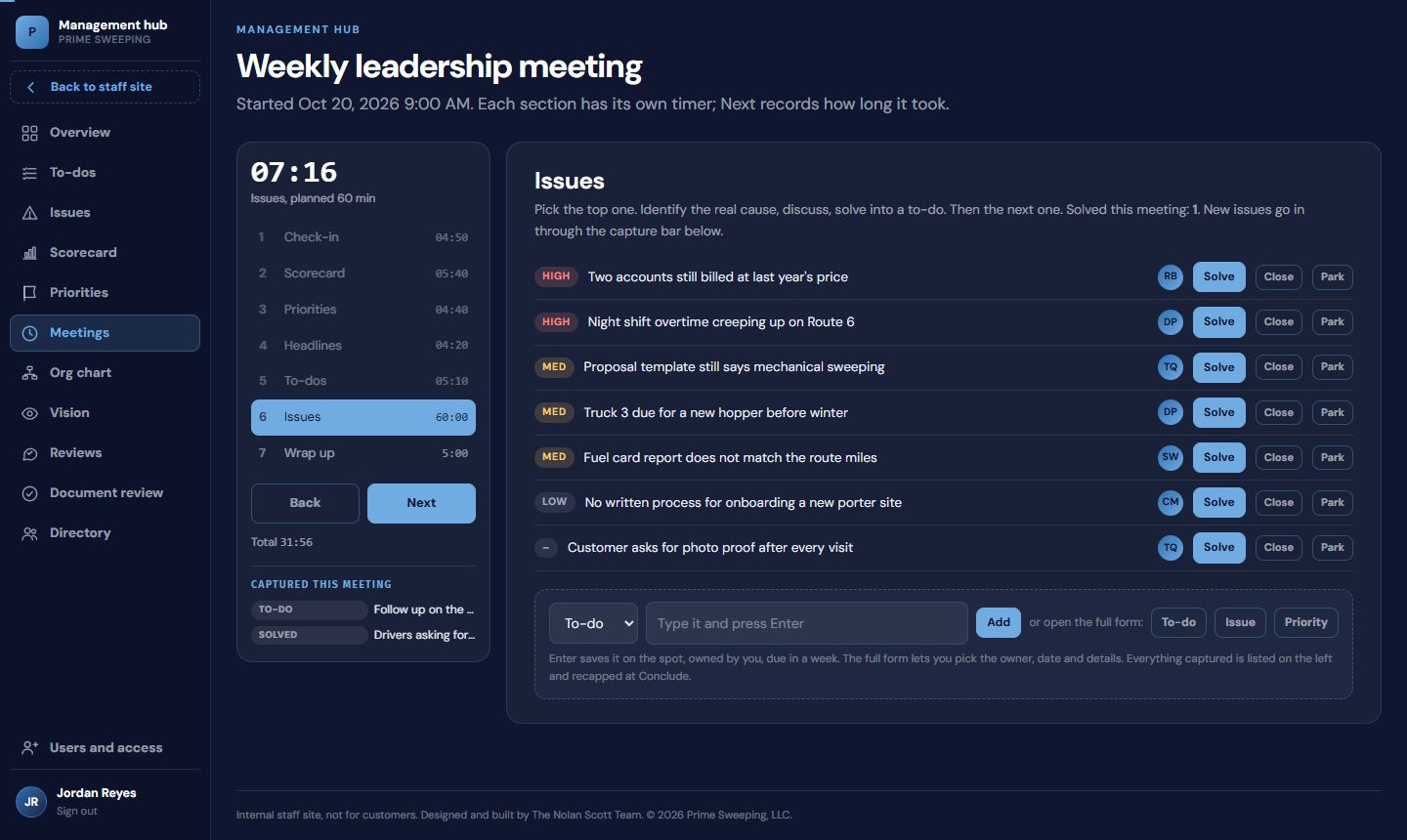
The issues list is where most of the meeting's time goes, and it is the part that decides whether the owner stays the bottleneck. Every open problem lives in one list, filtered by area, and each is tagged by what it needs: data, a decision or something built. That tag is useful on its own. An issue waiting on data should not burn twenty minutes of the leadership team's time; it gets assigned to whoever can pull the data by next week.
The meeting works issues most important first. The goal for each is to solve it, and solve has a specific meaning in the hub: it turns the issue into a to-do with one owner and one due date. A conversation that ends with "we should look into that" has not solved anything. A conversation that ends with a named person and a Thursday date has.
Two other details keep the list honest. Long-term items that are real but not for this quarter are parked, and they stay on the list where they can be pulled back. And to-dos come in three kinds: team, board-only and private. A repeating to-do makes its next one when it is ticked off, so the Friday receivables call happens every Friday without anyone remembering to add it.
The to-do list also closes the loop the following week, when last week's to-dos come back up as done or not done. Over a few months that becomes a plain record of who follows through, which is information an owner used to carry around in their head.
A timed agenda and the summary every meeting leaves
The meeting runs on a timed agenda, one section at a time: the scorecard, the quarterly priorities, last week's to-dos, then the issues list with whatever time remains. Each section has a time box, and the runner shows it. That keeps the scorecard review from turning into a forty-minute conversation about one red number, and it protects the time for issues, which is where the actual work of the meeting happens.
A capture bar at the bottom of the runner adds a to-do, an issue or a priority without leaving the meeting, so a point raised during the scorecard review goes straight onto the issues list and the section keeps moving. The hub also carries other agendas: a quarterly session, a one-on-one, or a meeting on topics of your own. The weekly leadership meeting is the one that runs every week.
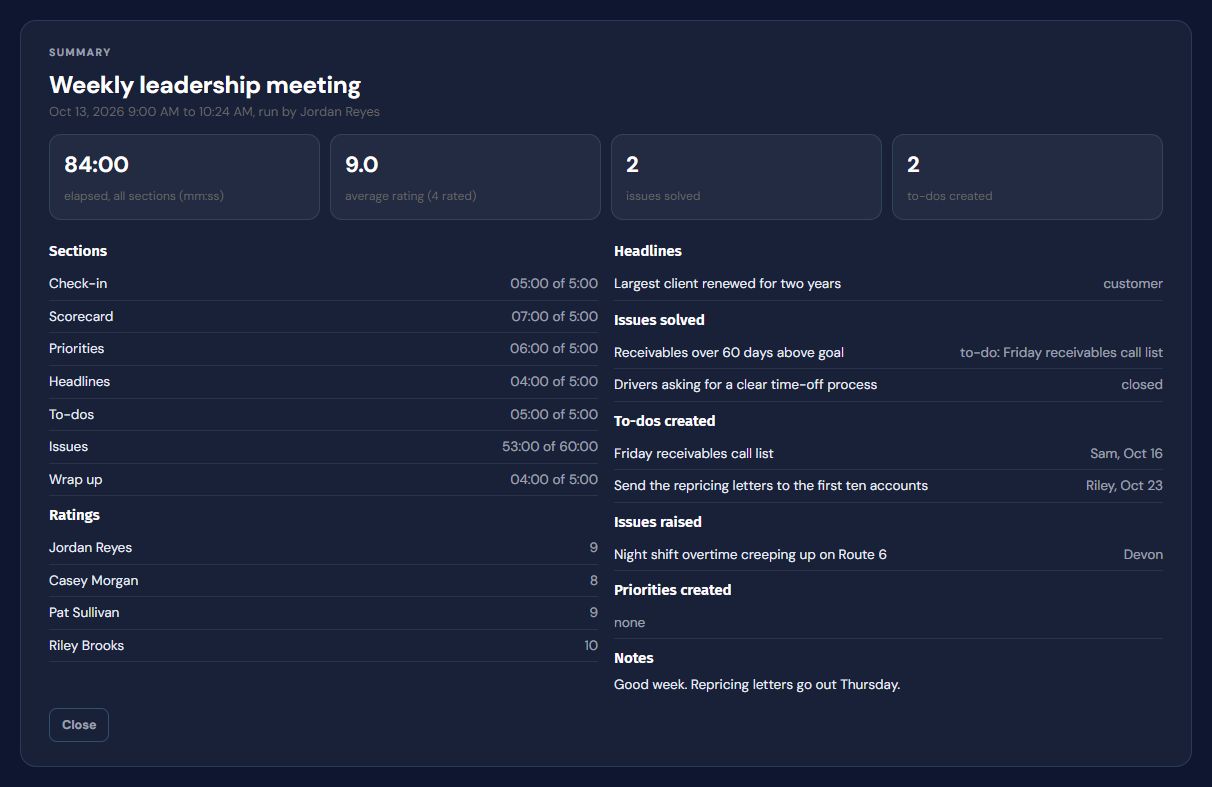
Every meeting leaves a summary: the time spent in each section, the ratings, what was solved, what was assigned and the notes. The summary is what makes the meeting independent of whoever led it. A manager who missed the meeting reads it in two minutes. An owner who stepped back for a month can read four of them and know where the company stands. And a buyer in diligence can read a stack of them and see a leadership team that works problems without waiting on the seller.
Running the meeting from a phone
A service company's leadership team is rarely all at one table. At Prime the sweeping runs overnight across metro Atlanta and the day porter work runs during the day, so the people who own the numbers are often in a truck or on a property when the meeting starts. The meeting runner works on a phone: the same agenda, the same timer, the same issues list and the same capture bar, run from the truck or the job site.
That matters more than it sounds. A meeting that requires everyone in the office drifts toward whoever is in the office, which is usually the owner. A meeting that runs from a phone keeps the field managers in it, which keeps their numbers and their issues in front of the leadership team every week.
Each person also has a home screen, My week, that shows their numbers against goal, their to-dos, the issues they own, the quarter's priorities and a countdown to the next meeting. It keeps the week's commitments visible between meetings, so the meeting itself is a review of work already in motion.
What sits around the meeting
The weekly meeting is the center of the management hub, and the rest of the hub supports it. The Org chart shows seats with a title, the person in each, who it reports to and the five things it is responsible for, so an empty seat is visible and every measurable has a seat to belong to. The Vision page holds purpose and niche, the long-range target, the three-year outlook and the one-year plan, which is what the quarterly priorities are chosen against. Reviews are a quarterly conversation per person, measured against their seat and the company's values, with history kept per person. Document review lets the board approve a document without an email chain, and the Directory lists everyone and every outside partner.
You can see each of these screens, running on sample data, in the management hub section of What We Built. None of it is exotic. It is the ordinary machinery of a company that runs week to week without depending on one person's memory.
Where to start
If your weekly meeting is a status round that ends with everyone waiting on you, the first change is usually the scorecard: pick the handful of numbers, give each one an owner and a goal, and start the history this week. The rest follows from there. This is the kind of work we do as a fractional Chief Strategy Officer, for owners one to three years from a sale or building a company that can grow without them, and our consulting page explains how that works.
If you would like to talk through where your own time goes and what the meeting would need to carry, book a conversation with me. We start with where your week goes today.