
Prime Sweeping sweeps parking lots overnight across metro Atlanta, and nobody has to sit down in the early evening and work out in their head who goes where. Whoever is running the office picks the night, marks which drivers are out and presses Balance. The Route Balancer reorders every stop across the trucks that are running, keeps every driver inside the shift cap, draws the routes on a map and prints a run sheet for each driver with the order, the arrive times, the minutes on site and the drive time. I designed and built it as part of the staff site for Prime, a company I am a partner in, and of every tool on that site it is the one I show first. This article walks through how it works, screen by screen, and why a buyer should care about a page that sorts parking lots.
The night used to live in one person's head
In an overnight route company, the plan for tonight is where operating knowledge piles up. Which lots cannot be swept until the stores close. Which ones have to be finished before the first employees arrive in the morning. Which truck can absorb two more stops when a driver calls in sick. How long the crew really spends at a big retail center compared with a small office park. That knowledge builds up over years of nights, and for a long time the only place it lived was with the one person who knew every lot by heart.
That arrangement works until the person is unavailable. A vacation, a sick day, an owner who wants one Tuesday evening at home. When the person who builds the night is out, somebody guesses or the phone rings. A driver calling out at eight o'clock turns into a problem for exactly one person in the company.
A buyer reads this as owner dependence, and where the person is an employee, as key-person risk. Both come down to the same question in diligence: what happens to this company on the night that person is not there? Running without the owner day to day is the largest of the four value drivers we work on with owners, and I have written separately about why buyers discount a business that depends on its owner. In a company that works at night on a schedule, the nightly plan is one of the most concrete tests of it I know.
Pick the night, mark who is out, press Balance
The planner asks for very little. Pick the night of the week. Look down the list of routes and the drivers assigned to them tonight, and mark anyone who is out. Check the settings, which hold the shift cap, the time the trucks leave the yard, the minutes allowed for the yard and fuel stop, and how far stops are allowed to move. That last setting runs from keeping the routes exactly as they usually run, through moving a stop only when it saves a few minutes, to moving anything that helps. Then press Balance.
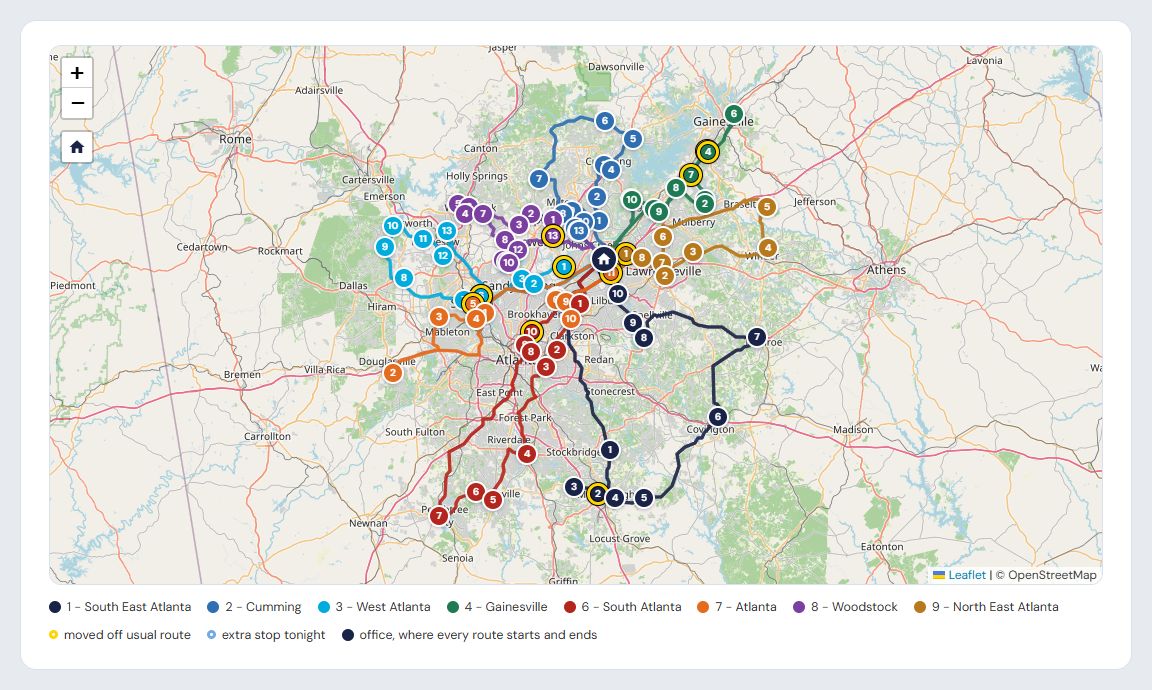
What comes back is the whole night. Every stop scheduled for that evening is put in order across the trucks that are running. The balancer works from two starting points, tonight's usual routes and a blank map fanned out from the yard, and keeps whichever plan comes out shorter, so when redrawing the territories saves time, it redraws them. Every driver's night has to finish inside the shift cap. The routes are drawn on a map in their own colors, with the yard pinned and every moved stop marked, so the person planning can see at a glance what changed from a normal night.
Four tiles sum up the result: the stops tonight, the longest night any driver will work, the crew cost, and the number of stops moved off their usual route. That last count is the price of the plan in disruption, and the setting for how far stops may move lets the office decide how much change a few minutes are worth. The full set of screens, including the planner itself, is on our What We Built page.
How many trucks tonight, decided on numbers
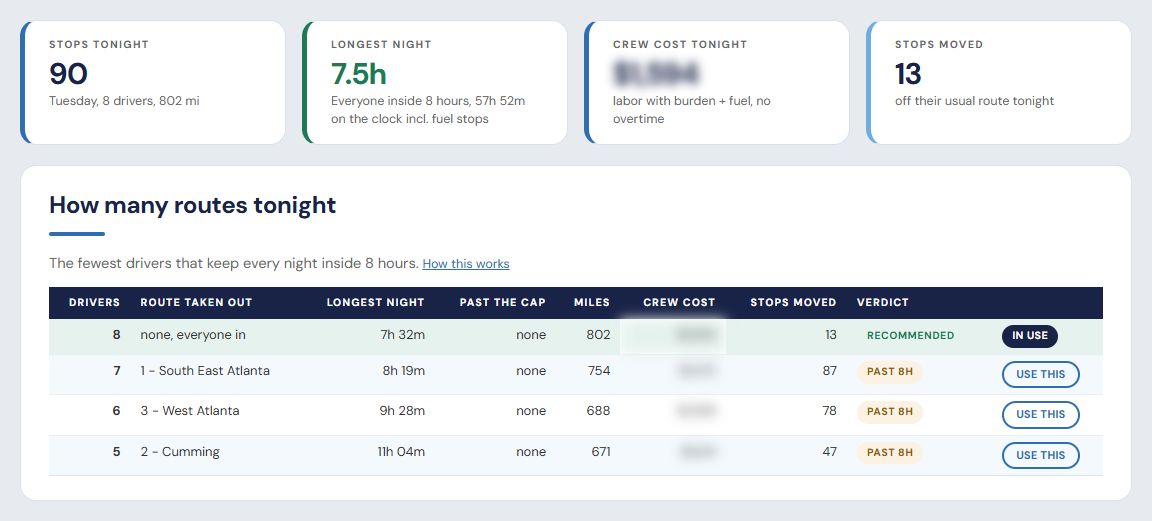
A routing tool that stops at the plan answers only half the question. The part of the balancer I like best asks the other half: does tonight need every truck? Below the summary tiles sits a ladder. The first row is the plan with every route running. Each row after it takes one more truck out, rebalances the stops across the trucks that are left, and shows the result: the longest night, whether anyone runs past the cap, the total miles, the crew cost and how many stops had to move. A verdict column marks the recommended row, and any row can be put into use with one button.
In the sample below, taking one truck out saves miles, pushes the longest night past the cap and moves nearly every stop on the schedule. So the answer that night is to run them all. On a lighter night the ladder can say the opposite, and then a truck, a driver and a night of fuel stay home. What changed is who can make the call. Deciding whether tonight needs every truck used to be a judgment the owner made from memory. Now it is a row in a table that anyone in the office can read, with the reasons printed beside the answer.
Crew cost is blurred in the screenshot because Prime's costs are Prime's business. The tool shows it, though, and it is the column that turns a routing question into a financial one.
A run sheet in every driver's hand
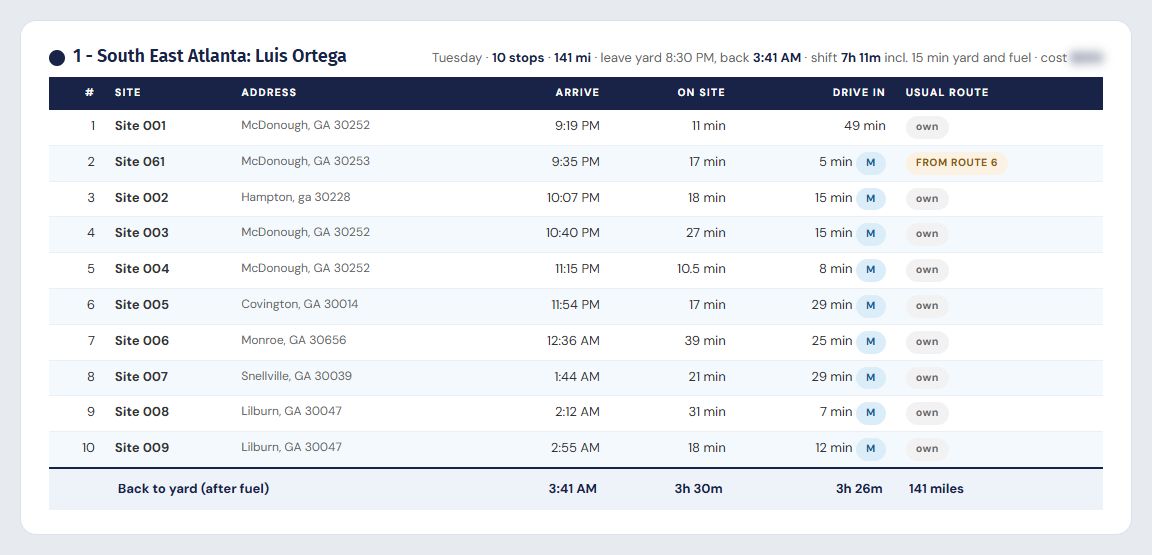
Once the plan is set, the balancer prints a run sheet for each driver. The header carries the route, the night, the number of stops, the miles, when the truck leaves the yard, when it gets back, and the length of the shift including the yard and fuel stop. Below it is one line per stop, in order: the site, the address, the arrive time, the minutes on site and the drive time in from the stop before. A last column shows each stop's usual route, so a stop borrowed from another truck tonight is labeled as a visitor, and the driver knows it is new to their night before they pull in.
The driver does not need to call anyone to find out where to go next, or to ask whether an unfamiliar lot on the list is a mistake. The office does not rebuild a sheet by hand when the plan changes at six in the evening. And the sheet comes out the same whether the person who pressed Balance has been with the company ten years or ten days.
The nights that do not go to plan
A plan that only works on a normal night is worth very little, because the unusual nights are exactly when the owner used to get pulled in. Four of them come up often enough that the balancer handles each one directly.
- A driver is out. Mark them out and press Balance again. Their stops move to the trucks that are in, the map redraws, and the ladder shows whether the remaining trucks can cover the night inside the cap. If they cannot, the planner can add a truck for the night: a relief driver, a storm night, a new hire riding their first route.
- Time windows. Some lots cannot be swept until the business closes, and some have to be finished before it opens. Each stop carries a start-after and a finish-before time, and the order respects both, so a truck never arrives at a lot still full of cars just because it happened to be closest.
- Monthly and occasional work. Not every job is on a weekly pattern. Monthly and occasional jobs appear as a pick list for the night, so the office adds this week's extras and the balancer fits them in with everything else.
- Making tonight the new normal. When tonight's plan beats the standing routes, one button saves it as the usual route, and the next week starts from it.
Each of these used to be a phone call to the one person who knew the answer. Now each is a few clicks by whoever is running the office that evening.
One list of stops, edited once
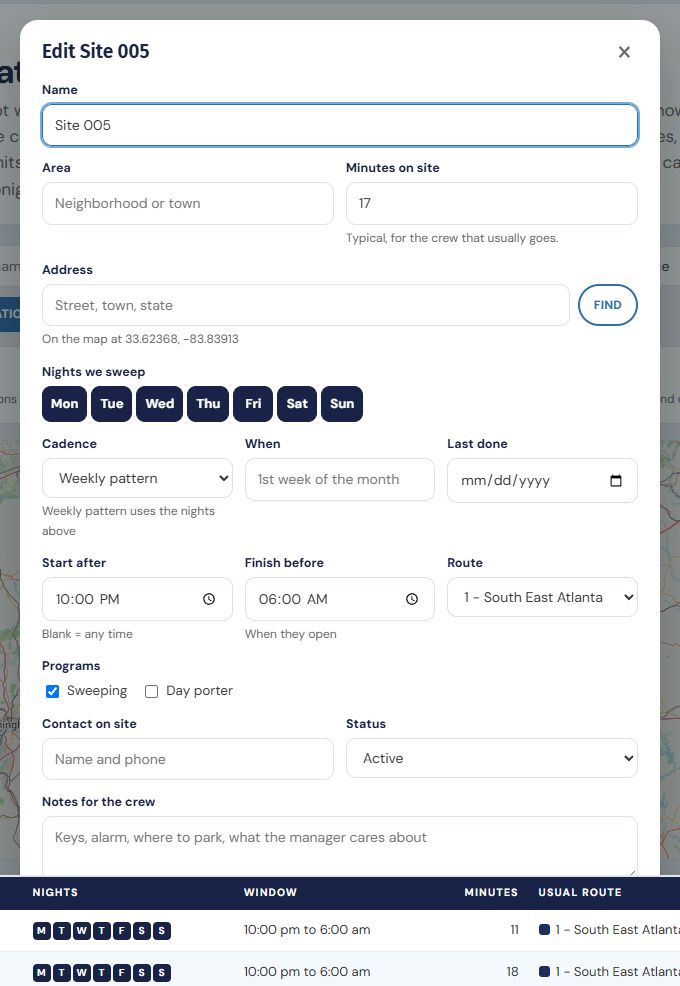
The balancer is only as good as what it knows about each stop, and that knowledge lives on one page. Locations is the list of every property the company services, shown on a map and in a table: which nights it is swept, the time window, the minutes on site and the route it usually rides. It can be searched and filtered, and a list can be imported or downloaded.
Opening a stop shows everything about it in one form. Tick the nights. Set the cadence, a weekly pattern or something like the first week of the month. Set when the lot can be swept, start after and finish before. Pick the usual route, mark whether it is sweeping or day porter work, and leave notes for the crew: keys, the alarm, where to park. When a customer changes their hours or adds a night, the office edits it here once, and tonight's routes pick it up. Nobody calls the driver, and there is no side spreadsheet the Route Balancer never sees.
The minutes on site matter beyond the route. They are the same measured minutes the quoting tool prices, which I walk through in how to price field service work from measured time. The prospect locator uses the same routes to work out the extra drive minutes a new site would add to the night, and those minutes go into the quote. So the night's plan and the price of the next job rest on the same numbers. When a lot turns out to take longer than it used to, the change shows up in both places.
What a buyer sees on a Tuesday night
When I look at a route company from the buyer's side, one of the first things I want to know is who plans the night and what happens when they are gone. At Prime the answer is a screen. A new office hire can pick the night, mark who is out, read the ladder and print the sheets, and the stops, windows, nights and minutes behind that plan belong to the company as data it can hand over at closing. Prime owns the tool outright, with no software subscription behind it.
That is what moves a company from "the owner is the business" to "the business runs," and it shows up in the multiple. The consulting page puts the arithmetic plainly: "On earnings of $850K, half a turn is over four hundred thousand dollars at closing, and it is the same business." The route plan is only one piece of that, alongside written procedures, a scorecard with history and an org chart with names in the seats. It is also the piece a buyer can watch work on any given night.
The pattern behind it is the one I describe on our consulting page: find the work only the owner can do today, write it down, and put it on a screen the team can use without calling the owner. For Prime, the nightly routes were near the top of that list.
If your nights still run through you
If you run a route business and you are still the person who builds tomorrow's night in your head, that is worth a conversation, whether you plan to sell in a few years or to grow past the point where you can hold every stop in memory. Every company's routes run differently, and the hard part of any build is learning how yours actually work. We usually start by talking about where your time goes. You can book a time with me at calendly.com/nolan-nolanscottteam.